The Altar, the Beast, and the New Man
OCT 16, 2026 · STEPHEN CANTRELLE
The Big Idea
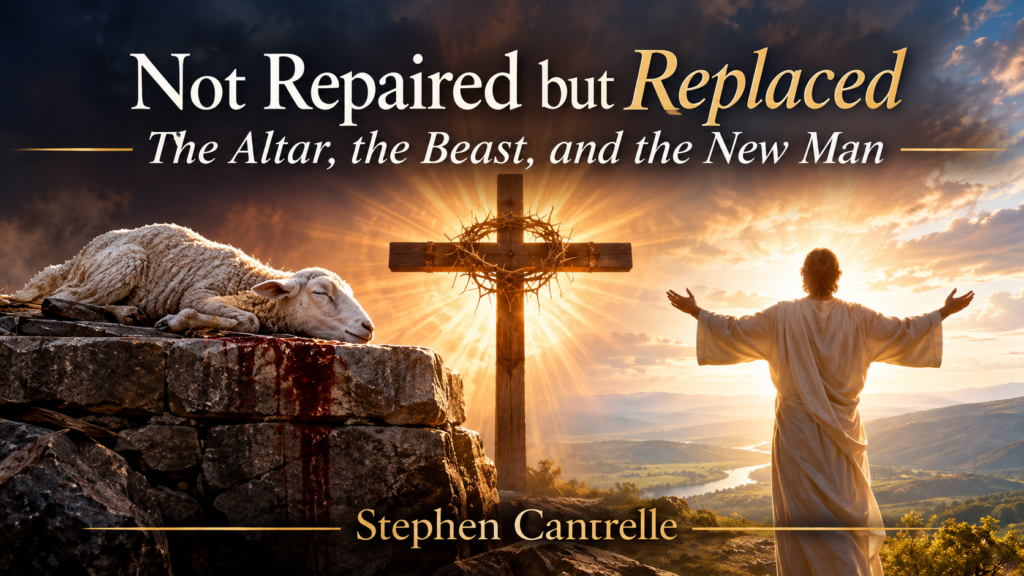
The blood that turns away God’s wrath is also the death of the old human race that began with Adam.
God does not repair that old version of us. He ends it in Christ. He replaces it with something new: “Christ in you, the hope of glory” (Colossians 1:27).
Here is the simple line of the argument. When people are cut off from God’s Spirit, they sink toward the level of the animals. The Bible says this clearly. The prophets picture human kingdoms as wild beasts. The Old Testament altar meets people at that lower level with the blood of animals.
But only Jesus, the true Man, could finish what those animal sacrifices pointed toward. At the cross, God’s judgment is directed not at a mere arbitrary penalty, but at the necessary termination and execution of the unsustainable Adamic constitution, the conduit of sin that must die. God’s final word then rests on the new person who rises with Christ.
This is not a new teaching. It is the old gospel told as one story. Forgiveness, the establishment of the new temple of God, and the daily walk of faith are different facets of the same glorious reality.
Three Levels of Life
- Animals (Genesis 1:20, 24)
- Has: A living soul, made “after their kind.”
- Lacks: God’s image, the right to rule, a human spirit, and the ability to talk with God.
- The First Adam (Genesis 1:26; 2:7; 1 Corinthians 15:45)
- Has: God’s breath, a human spirit, the structural image of God (as a rational, volitional creature), and the right to rule.
- Lacks: Life that comes from inside himself, and active, functional fellowship with God.
- Jesus and the New Creation (1 Corinthians 15:45–49; 2 Corinthians 5:17)
- Has: A life-giving Spirit; people filled and kept by the Holy Spirit.
- Lacks: Nothing. This is the goal.
Moses uses the same words for the life of animals and the life of Adam. What made Adam different was not the kind of soul he had. It was what God did with it. God breathed into him. God gave him His image. God spoke with him.
Adam stood higher than the animals because of God’s gift.
THE HUMAN SPIRIT
One term needs defining before the rest of the story makes sense. By the human spirit I mean the invisible organ within, given to man to commune with God. It is not a demonic spirit, and it is not God’s Spirit. It is the part of us made to receive Him. Scripture speaks of it plainly: God “forms the spirit of man within him” (Zechariah 12:1); “it is the spirit in man” that gives understanding (Job 32:8); “no one knows the thoughts of a man except the spirit of the man which is in him” (1 Corinthians 2:11); and God’s Spirit “bears witness with our spirit” (Romans 8:16). Worship happens here: “those who worship Him must worship in spirit and truth” (John 4:24).
This article assumes a three-part human being: spirit, soul, and body (1 Thessalonians 5:23; Hebrews 4:12). The animals have a soul. Adam alone had a spirit. That is the difference God’s breath made.
The human spirit was made for union with God’s Spirit. It could be turned toward independence. That one sentence carries the whole fall.
Paul is careful. He does not say the new life in Christ is a return to the Garden of Eden. “The spiritual is not first, but the natural; then the spiritual” (1 Corinthians 15:46). Adam was a picture of the One who would come later. Jesus was always the real pattern. The garden was only the first draft.
Living Like the Animals That Die
When Adam lost close fellowship with God, he did not turn into an animal. He still carried the structural image of God in his makeup and remained responsible for his choices.
Yet he lost the life of the Spirit that had lifted him above the animals. He began to live at their level. The Bible does not soften this.
THE ROOT: “YOU SHALL BE LIKE GOD”
The fall did not begin with a piece of fruit. It began with an offer of independence: “You will be like God” (Genesis 3:5). The human spirit, made for union with God’s Spirit, turned toward independence. It went dead toward God (Ephesians 2:1), and the soul took over as the ruling self.
That is why the act of sin is not the root offender. Acts are the fruit. Jesus says the evil things come from within, out of the heart (Mark 7:21–23). Paul says the mind set on the flesh “does not subject itself to the law of God, for it is not even able to” (Romans 8:7). He says we were “by nature children of wrath” (Ephesians 2:3). Wrath falls on what we have become, not only on what we have done. Through one man’s disobedience the many were “made sinners” (Romans 5:19). That is a change in constitution, not merely a bad example.
THE DESCENT
Psalm 49 says that a person in all his pride, if he has no understanding, is “like the beasts that perish.”
Asaph admits in Psalm 73 that when he only looked at life on the surface, “I was like a beast before You.” He only recovered when he came into God’s presence.
In Romans 1 people trade the glory of God for images of birds, animals, and crawling things. The rule is simple: we become like what we worship.
Jude and 2 Peter say that people without the Spirit act “like unreasoning animals,” driven by instinct.
NEBUCHADNEZZAR: A CLEAR EXAMPLE
Daniel 4 shows the whole process in one man.
King Nebuchadnezzar boasts about the great city he built: “Is this not Babylon the great, which I myself have built?” That is the serpent’s offer in a king’s mouth. God takes away his human heart and gives him the heart of an animal. He eats grass. His hair grows long like feathers. He lives with the beasts.
Then he looks up to heaven, and his mind returns.
The point is clear. When a person is cut off from God, he is not raised up into independence. He is lowered. True humanity comes back only when he looks up.
Human Kingdoms Look Like Beasts
Daniel sees the same four kingdoms in two different ways.
From the earth they look like a tall, impressive statue of a man. From heaven they look like four wild beasts rising out of the sea. The kingdoms stay the same. Only the viewpoint changes.
From below, human power looks glorious. From God’s view it looks like a beast.
Two details matter.
First, one of the beasts is given a human heart and made to stand like a man. A beast only becomes human when heaven gives it a heart.
Second, after the beasts comes “one like a son of man.” He receives the right to rule that the beasts had taken. This is God’s original purpose for humanity finally fulfilled in Jesus.
The book of Revelation continues the same picture. The great beast looks terrifying, yet its number is “the number of a man.” It is fallen humanity organized against God. Opposite it stands the Lamb who was killed and now lives.
Why Animals Were Offered on the Altar
If people now live at the level of the animals, the sacrifices make sense. God meets them where they are.
The first death in the Bible is an animal’s. Its skin covers Adam and Eve.
Leviticus says the life is in the blood. That life is the same kind of soul-life that humans and animals share. God accepts it on the altar to cover the worshiper’s life.
The person offering the animal presses his hand on its head. On the most important day of the year the high priest confesses the nation’s sins over a goat. The animal is identified with the person. The animal dies in the place of the person’s lower, creaturely self.
The animal had to be perfect. A substitute cannot carry someone else’s guilt if it is already guilty itself. That is why it points so clearly to Jesus, who never sinned yet took our sin upon Himself.
But animal blood could never finish the job. An animal is lower than a human being. It can picture the death of the old self, but it cannot become the head of a new human race.
So Jesus did not bring a better animal. He became human Himself. He took on our condition. He brought that old condition to its end.
The Mercy Seat and the End of the Old Self
In Romans 3 God presents Jesus as the place where wrath is turned away. This is the same word used for the gold cover on the ark of the covenant where blood was sprinkled.
Paul does not leave it there. He goes on to say that our old self was crucified with Christ (Romans 6:6). When One died, then all died (2 Corinthians 5:14). God condemned sin in human flesh.
The turning away of wrath and the death of the old self are not two different events. They are the same death seen from two sides.
From heaven’s side, God’s justice is satisfied through the execution of the unsustainable Adamic constitution. From our side, the old person is finished.
The cross is both something that happened outside us and something we were included in. Both are true.
WHERE THE WRATH FELL
Romans 8:3–4 puts it as plainly as anything in Scripture:
“For what the Law could not do, weak as it was through the flesh, God did: sending His own Son in the likeness of sinful flesh and as an offering for sin, He condemned sin in the flesh, so that the requirement of the Law might be fulfilled in us who do not walk according to the flesh but according to the Spirit.”
Three things stand out. The target of the condemnation is sin in the flesh, the Adamic constitution, not a list of acts. The Son came in the likeness of sinful flesh: He took our condition so that He could end it. And the result is that the law’s requirement is fulfilled in us, by the Spirit. That is not a legal credit. It is a new life.
The wrath was poured out against the Adamic, sinful nature, and there is no one else to judge. The offender has been executed. This means wrath is not only satisfied, it is exhausted. Nothing is left unjudged and no one is left to condemn. That is why Paul can say, “There is therefore now no condemnation for those who are in Christ Jesus” (Romans 8:1).
CRUCIFIED WITH HIM
Galatians 2:20 holds the whole argument in one sentence:
“I have been crucified with Christ; and it is no longer I who live, but Christ lives in me; and the life which I now live in the flesh I live by faith in the Son of God, who loved me and gave Himself up for me.”
“I have been crucified with Christ” is the execution of the old self. The Greek is in the perfect tense: a completed act with a standing result. “It is no longer I who live, but Christ lives in me” is replacement, not repair. “The life which I now live in the flesh I live by faith” is progressive sanctification, the new life leaning on the indwelling One.
Notice the order. Paul puts the co-crucifixion first and “gave Himself up for me” second, in the same sentence. He does not treat them as rival explanations. “For me” and “crucified with Him” are the same event seen from two sides, like the mercy seat and the death of the old self. A reading that keeps only “He died in my place” cannot explain why Paul says I was crucified. Second Corinthians 5:14 ties the two together in one verse: “One died for all, therefore all died.” The “for” is representative: He died as the One in whom the race died. See also Colossians 3:3: “You have died.”
When Paul says “the life which I now live,” the “I” is the new person, living by Christ’s life. It is not the old Adamic self continuing under new management.
Justification, The Law, and The New Temple
As Romans 3:20 reminds us, the law cannot declare anyone righteous; rather, through the law comes the clear diagnosis and knowledge of our sin. The law acts as a mirror exposing a broken system that cannot fix itself.
This leads directly to the raw, experiential cry of human inability found in Romans 7. Paul says it with crystal clarity: “I do not understand what I am doing… no longer am I the one doing it, but sin that dwells in me” (Romans 7:15, 17). Three times he says sin dwells in me (vv. 17, 18, 20). Good does not dwell “in my flesh.” The willing is present, but the doing is not. He sees “a different law in the parts of my body waging war against the law of my mind, and making me a prisoner of the law of sin” (7:23).
Paul’s own word is “sin that dwells in me.” I call this the Adamic nature, and Ephesians 2:3 gives that word (“by nature children of wrath”). The slavery is constitutional, not merely a series of bad choices. The willing “I,” the inner person who joyfully agrees with the law of God, is not the problem. The whole self is enslaved to the sin that dwells in it. Here is the old human condition described from the inside, the man in Adam standing before the law. So Paul asks: “Wretched man that I am! Who will set me free from the body of this death?” (7:24).
The answer comes at once. “Thanks be to God through Jesus Christ our Lord!” (7:25), and then: “There is therefore now no condemnation” (8:1). The law of the Spirit of life in Christ Jesus has set us free (8:2). The deliverer is Christ, and the deliverance is His death and resurrection.
Because the old Adamic constitution is an inescapable conduit of sin, human effort is helpless. Yet, as Romans 3:31 shows, faith does not nullify the law. It establishes it. The righteous demand of the law is fully upheld because the old, law-breaking self is executed rather than excused.
In this light, justification is God’s creative act that puts the new house in order. He puts the old self to death, raises the new person in Christ, and declares that person righteous because He has made them so. It is marked by the resurrection and the indwelling of the Holy Spirit received at Pentecost. God does not pronounce a verdict over the old self while it is still unchanged. He does not declare the old self righteous; He puts the old self to death and sets up a brand-new temple, declaring the new person in Christ to be righteous because that is what they are.
The order matters. God first acts: death, resurrection, new temple. Then He declares. The declaration rests on the creative act.
“GOD JUSTIFIES THE UNGODLY”
Paul says God “justifies the ungodly” (Romans 4:5). This fits the argument exactly. God justifies the ungodly by putting them to death in Christ and raising them righteous. The ungodly person is the one who believes and is placed into Christ’s death. The one who stands justified is the person raised in Him, not the Adamic person who went into the grave. God does not make the old self right. He ends it and makes a new man right in its place.
Unable, Yet Still Responsible
Someone may ask: if people cannot keep God’s law under the old nature, how can He still hold them guilty?
Paul is blunt. The mind controlled by the old nature cannot submit to God’s law. It is not even able to. The law itself is good. The problem is us.
We see the same pattern in ordinary life. An addict is still responsible for the damage he causes. A person who cannot pay a debt still owes it. A long-time liar is still to blame even if he cannot simply decide to become truthful overnight.
“Ought implies can” works when the inability comes from outside. It does not work when the inability comes from what the person has become. The human spirit turned toward independence, and the whole self followed it. The inability is the person’s own.
The old human condition cannot be improved by effort. It has to die. That is why God promises a new heart and His own Spirit living inside us. Then we actually walk in His ways.
Progressive Sanctification: Living by Faith
The new life is already complete in Christ. At the same time, it is still being worked out in daily experience. What it never needs is any attempt to repair the old self.
This is where progressive sanctification takes root. Now that the new temple is erected and inhabited by the Spirit, it requires care: the daily, conscious choice to lean on the indwelling Spirit rather than slipping back into autonomous Adamic independence. As Scripture declares, “The righteous shall live by faith.”
Christ in You
The story runs from the garden to the throne.
Adam was lifted above the animals by God’s breath and given the right to rule. His spirit was made for union with God’s Spirit. It turned toward independence. Cut off from God, the human race sank. It built kingdoms that looked impressive from the ground and like beasts from heaven.
God met that race at the altar with the blood of animals, a picture of the death that was needed. Then the true Man came. He took on our humanity. He carried it to the cross. There the old humanity was judged, executed, and finished.
The real mercy seat was not a gold lid in a tent. It was a body on a tree. In His resurrection a new creation stood up. God declared it righteous because it was.
Now the Son of Man lives in those who belong to Him. Not a repaired version of the old Adam, but Christ Himself formed in us by the Spirit.
God never planned to fix the first draft. He planned to bring out the finished man.
The blood is the end of the beast in us, and the beginning of the Man.