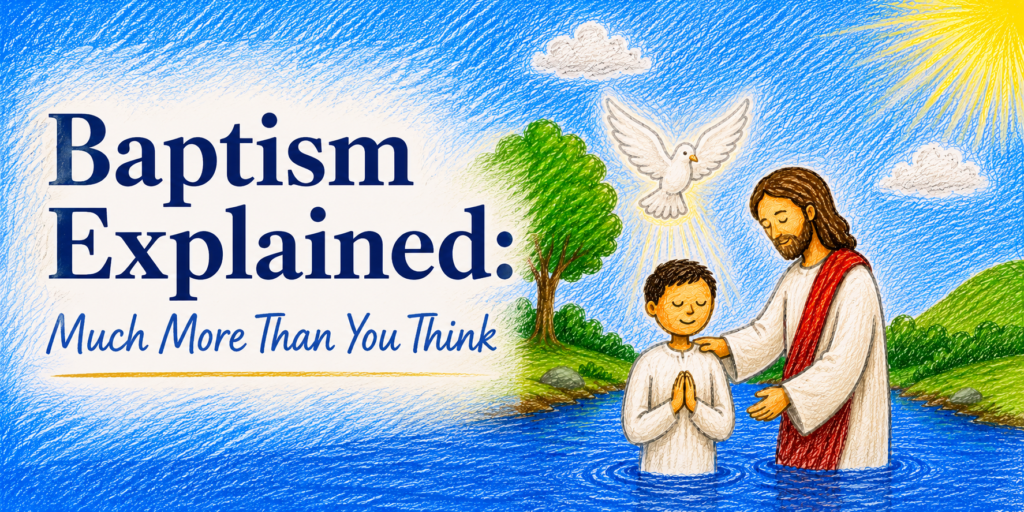
There is a reason Jesus did not begin his public ministry with a sermon. He began it by going to the Jordan.
John was baptizing. The crowds were coming — not to hear lectures on covenant theology, not to enroll in a formation program, but to go under. To enter the water. To let something happen to them that they could not do to themselves. Jesus joined them, and in that act announced something about the shape of the life he was about to invite people into. Before he called a single disciple, before he preached a single sermon, before he healed a single person, he stood in the water and let himself be immersed. The sign came first. The ministry that would give the sign its full meaning came after.
We have read past this too quickly for too long.
The Sign John Gave
John’s baptism was a baptism of repentance. That word — repentance, metanoia — means a complete reorientation of mind, a turning so total that the person who turns is no longer facing the same direction. But metanoia does not originate in the New Testament. It arrives there as the fulfillment of something God had promised centuries earlier through the prophet Ezekiel.
I will give you a new heart and put a new spirit in you, God said through Ezekiel. I will remove from you your heart of stone and give you a heart of flesh. And I will put my Spirit in you and move you to follow my decrees. (Ezekiel 36:26–27)
The sequence in Ezekiel is surgical. God does not repair the old heart. He removes it. The heart of stone — the self-hardened, self-organizing center of the old life, the seat of the will and desire that builds towers and accumulates identity and secures its own transcendence — is taken out. Not softened. Not improved. Replaced. A new heart is implanted, and then the Spirit is placed within it to animate it from the inside.
This is metanoia at its deepest root. You cannot reorient a heart of stone. It must be replaced. The crowds coming to the Jordan were, consciously or not, responding to a promise God had made to Israel: I will cleanse you. I will give you a new heart. John’s baptism was not announcing something new. It was announcing the arrival of what Ezekiel had been waiting for.
The imagery of John’s sign carried its own theology. You went into the water. You went under. For a moment — the briefest moment — you were submerged, surrounded, held in a medium not of air or land or the ordinary world in which your ordinary self operated. And then you came up.
Something went down that did not come back up. The person who emerged was not simply wet. He was, in the language the sign was reaching for, a different person — or at least a person who had declared his willingness to become one. Death. Burial. The first tremor of resurrection. John’s baptism did not complete the sequence. It named it. It pointed toward a baptism that would.
I baptize you with water, John said. But one who is more powerful than I is coming. He will baptize you with the Holy Spirit and fire.
The sign was always pointing beyond itself. The water could illustrate the death. Only the Spirit could enact it. Ezekiel had said so first.
The Death Paul Understood
No one in the New Testament pressed further into the meaning of baptism than Paul. What John’s sign pointed toward and Ezekiel’s promise had named, Paul unpacked with surgical precision.
Do you not know that all of us who have been baptized into Christ Jesus were baptized into his death? Romans 6 is not a passage about a ritual. It is a passage about a transfer of life-source. The one who is baptized into Christ’s death has submitted the self — the organizing center of the old life, the builder of towers, the accumulator of identity and security through self-made means — to the same death Christ died. Not metaphorically submitted. Actually submitted.
We were buried therefore with him by baptism into death. The burial confirms the death. You do not bury what is still living. The old self — Paul’s palaios anthropos, the old human, the self that was its own lord — goes into the ground. This is the heart of stone Ezekiel named. This is the self that built Babel. It goes under and it does not come back up.
Just as Christ was raised from the dead by the glory of the Father, we too might walk in newness of life. The resurrection is not the restoration of the old self in improved condition. It is the emergence of a life whose source has changed. What rises is not self-managed or self-secured. What rises is the new heart Ezekiel promised — a person now inhabited by the Spirit of the one who raised Jesus from the dead.
This is what Paul means when he says I have been crucified with Christ. It is no longer I who live, but Christ who lives in me. The I has not been refined. It has been replaced. Not annihilated — Paul is still Paul, still writing letters, still carrying a distinct personality into every room he enters. But the source from which that life flows has changed entirely.
The life I now live in the flesh I live by faith in the Son of God, who loved me and gave himself for me. Galatians 2:20 is not a devotional sentiment. It is a description of what genuine discipleship produces: a person in whom self has been displaced by Spirit, in whom the old compulsion to build and secure and perform has been put to death, in whom the new heart Ezekiel promised is now beating.
This is disciple-making. Not the management of religious behavior. Not the transmission of doctrinal content. The death of the old self and the emergence of a life hidden in God.
The Proximity That Prepared Them
The disciples did not arrive at Pentecost unprepared. Three years of unbroken proximity to Jesus had been doing something to them that they could not fully name while it was happening.
They had not attended a teacher. They had lived inside a life. Everything they encountered — every storm, every crowd, every moment of failure and restoration, every meal, every prayer overheard in the dark — was formation material. The curriculum was not information about Jesus. The curriculum was exposure to Jesus. Total, sustained, daily exposure to a human life being lived entirely from union with the Father.
They watched a man who never once constructed his own identity, never secured his own significance, never reached for transcendence through self-made means. Every word he spoke came from the Father. Every action flowed from the Spirit. The self that might have built towers was wholly surrendered to the one who sent him. The Son can do nothing of his own accord, but only what he sees the Father doing.
Three years of watching that. Three years of being formed by proximity to it. Three years of being covered, as the rabbis said, in the dust of his feet.
And yet Jesus told them it was not enough. It is for your good that I am going away. The proximity had been essential. It had prepared the soil. But what the soil needed was not more proximity to the physical Jesus. It needed the seed the Spirit would plant — the same life they had watched from the outside, now growing from the inside. The new heart Ezekiel described does not come from watching. It comes from the Spirit taking up residence within.
The Prayer That Named the Destination
On the night before the cross, Jesus prayed. John 17 is not a pastoral prayer in the ordinary sense. It is the theological summit of the Gospel — Jesus naming, in the hearing of his disciples, exactly what he intended the formation process to produce.
Holy Father, keep them in your name, which you have given me, that they may be one, even as we are one.
Not organizationally unified. Not doctrinally aligned. One — as the Father and Son are one. The standard of the oneness Jesus is praying for is the relational union of the Trinity itself. He is not asking for something less than that. He is asking for that.
As you sent me into the world, so I have sent them into the world. The sending is modeled on the same union. The disciples are to go into the world the way Jesus went — not from self, not from institutional backing, not from programmatic strategy, but from union with the Father, from immersion in the Spirit, from a life whose source is not themselves.
I in them and you in me, that they may become perfectly one. The preposition matters. Not beside. Not near. Not supported by. In. The same in that describes the relationship of the Son to the Father. Jesus is praying his disciples into the Trinitarian life itself.
This is the destination Ezekiel’s promise was always moving toward. The new heart was never merely about moral renovation. It was about capacity for union — a heart soft enough, alive enough, Spirit-inhabited enough to be drawn into the relational life of God himself. What self vacated, the Trinity inhabits. The one who went under as a self-constructing, tower-building creature comes up as a person being drawn into the love the Father and Son have shared from before the foundation of the world.
Death is not the destination. It is the doorway. Union is the destination.
Pentecost as Fulfillment
Fifty days after the resurrection, the prayer was answered.
The disciples were gathered. The Spirit came — not gently, not quietly, not as a private interior experience, but as wind and fire, as something that filled the house and filled the people and spilled out into the street. What had been external and biographical — three years of proximity to the physical Jesus — became internal and permanent. The Spirit did not visit. He took up residence. Ezekiel’s promise, centuries old, was fulfilled in a single morning.
Peter stood and preached and three thousand people responded. But the number is not the point. The point is what Peter offered them at the end of the sermon.
Repent and be baptized, every one of you, in the name of Jesus Christ for the forgiveness of your sins. And you will receive the gift of the Holy Spirit.
The sequence is John’s sequence, now fulfilled. Repentance — the death-declaration, the consent of the heart of stone to be removed. Baptism — the sign of burial and resurrection enacted in water. And then: the gift of the Spirit. The new heart coming alive. The immersion the water sign had always been pointing toward. The answer to the prayer of John 17.
Death. Burial. Resurrection. The Spirit taking up residence. Union with the Trinity as the destination. This is the full sequence. This is what the sign was always carrying.
What This Means for Disciple-Making
For as many of you as were baptized into Christ have put on Christ. Galatians 3:27 is not about a ceremony. It is about a new identity — not constructed, not achieved, not accumulated through religious performance, but received. Put on. The self that went under dressed itself in Christ when it came up. The old garments — the identity built from reputation, approval, achievement, religious standing — stayed in the water.
You have died, and your life is hidden with Christ in God. Past tense. Already accomplished in the one who has genuinely gone under. The hiding is not a future hope. It is the present condition of the disciple. A life no longer exposed to the compulsions of self-construction, because it is no longer located in self. It is located in God.
The growth of the Spirit-controlled life is not the addition of religious activity to an otherwise unchanged self. It is the progressive displacement of self at every point where self once ruled — the new heart beating stronger, the Spirit’s voice growing more familiar, the union John 17 describes becoming more fully inhabited. This is sanctification. Not moral achievement. The Spirit expanding into the territory self once occupied.
This is what disciple-making means. Not the production of informed, church-attending, behaviorally compliant religious consumers. The death of the self that needs to build towers. The burial of the old heart of stone. The resurrection of a life sourced in the Spirit. The growth of that Spirit-controlled life displacing self day by day. And the destination — the destination Ezekiel foresaw, that Jesus prayed for in John 17, that the Spirit enacts from within — union with the Trinity. The disciple drawn into the same relational life that the Father and Son share, immersed in it, living from it, sent from it into the world.
John’s water pointed to it. Ezekiel’s promise named it. The cross accomplished it. The Spirit enacts it. Baptism signs it. John 17 is its destination.
The commission is to make disciples of Jesus. This — exactly this — is what that means.
❖ ❖ ❖