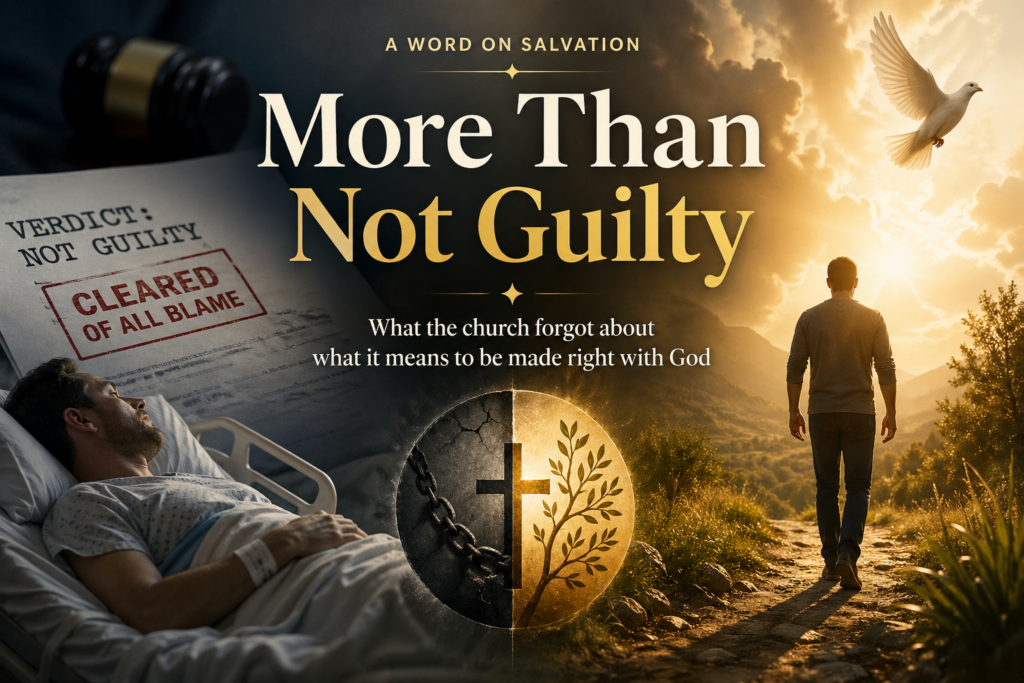
More Than
Not Guilty
What the church forgot about what it means to be made right with God
✦
Imagine you’ve been in a terrible accident. You’re lying in a hospital bed — broken bones, damaged organs, barely able to move. And the doctor walks in, looks at your chart, and says: “Good news. You are no longer at fault for the accident. You’ve been cleared of all blame.”
That’s good news. You needed to hear it. But you’re still lying there broken.
The declaration didn’t heal you. And healing is what you actually need.
What Does “Justified” Really Mean?
For five hundred years, most Protestant Christianity has taught that justification — being made right with God — is primarily a legal declaration. God looks at the sinner, sees the righteousness of Christ covering them, and pronounces a verdict: Not guilty.
That’s true as far as it goes. But it doesn’t go far enough.
The word Paul uses — the Greek word dikaioō — comes from a world where “righteous” meant something far richer than a courtroom verdict. It carried the weight of the Hebrew word shalom: things being as they ought to be. Whole. Functioning. Restored to their original design.
When the Bible says God justifies the ungodly, it isn’t only saying He clears their record. It’s saying He restores them — makes them right in the deepest possible sense.
“We are his workmanship, created in Christ Jesus for good works, which God prepared beforehand, that we should walk in them.”EPHESIANS 2:10
The Verse We Always Stop Too Soon
Most people can quote Ephesians 2:8-9 from memory: “For by grace you have been saved through faith — and this is not your own doing; it is the gift of God, not a result of works, so that no one may boast.”
And then we stop. But Paul didn’t stop there. He kept going: “For we are his workmanship, created in Christ Jesus for good works.”
In Paul’s mind, grace received through faith doesn’t just clear a verdict. It creates something new. It produces a person oriented toward the very works God designed them for. The works aren’t an extra credit assignment. They are the destination — the evidence that the restoration is real.
Faith pulls the trigger on grace — and grace empowers the works. Nothing about that sequence is optional.
Why This Matters More Than It Sounds
Here is the pastoral problem the church has largely ignored: if justification is only a legal declaration, then nothing in you necessarily changes. You’ve been pronounced innocent, but the broken person who needed healing is still lying in the hospital bed.
And so we get churches full of people who sincerely believe the right things — who have accepted Christ, who know they are forgiven — but whose inner life looks essentially the same as it did before. The same anger. The same fear. The same self-centeredness. Just now with a different label on it.
This isn’t a small problem. It is the central crisis of Western Christianity.
The Missing Piece: The Spirit Who Moves In
Here is what completes the picture. Justification — real justification, full justification — doesn’t just change your legal standing before God. It opens the door for the Holy Spirit to take up residence in you. And the Spirit doesn’t come to hang a certificate on the wall. The Spirit comes to change you from the inside.
The declaration and the transformation are not two separate events happening years apart. They belong together. The cross deals with the guilt of what you’ve done. The Spirit deals with the power of what you are. One without the other is half a gospel.
Think of it this way. If a house has been condemned, two things need to happen: the legal condemnation has to be lifted, and the house has to actually be repaired. A cleared title on a crumbling building helps no one live there.
God isn’t in the business of issuing cleared titles on crumbling buildings. He is in the business of moving in and renovating from the foundation up.
So What Changes?
Everything — eventually. Not all at once. Not without resistance. But the trajectory changes completely.
A person who has not only been declared righteous but who has received the Spirit of God has a new power at work inside them that wasn’t there before. A new desire. A new capacity for love that doesn’t come from willpower or religious effort. Works begin to emerge not because the person is trying harder, but because the life that produces them has actually taken root.
This is what Paul meant when he said “it is no longer I who live, but Christ who lives in me” (Galatians 2:20). He wasn’t speaking poetically. He was describing an experienced reality — a genuine displacement of the old self-directed life by the life of Christ within.
That is what justification was always meant to produce. Not just a verdict. A life.
✦
FOR THOSE WHO WERE SINCERE — AND WHO WERE TOLD ONLY HALF THE STORY