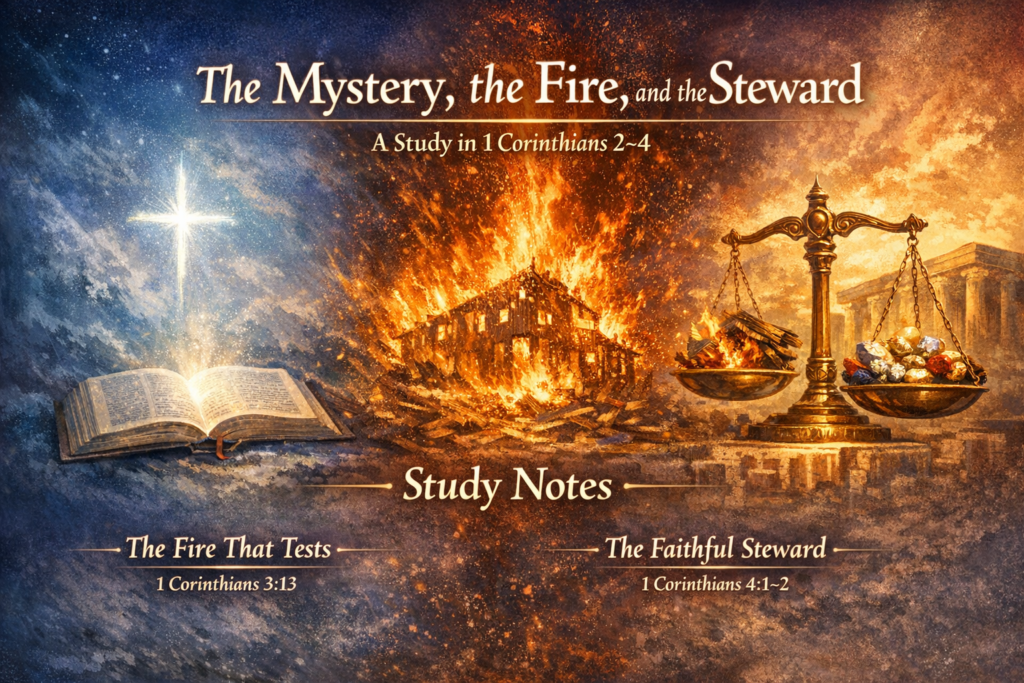
A Study in 1 Corinthians 2–4
Study Notes
I. The Fire That Tests — 1 Corinthians 3:13
Paul’s metaphor in verse 13 is precise in a way that is often flattened by preaching. The fire is not punitive. It is revelatory. The Greek word hopoion — “what sort” — is the key. The fire does not measure quantity of ministry output; it tests the nature of what was built. Not how much, but what kind.
The building materials Paul lists — gold, silver, precious stones versus wood, hay, straw — are not moral categories. They are durability categories. What survives the fire is what was built from the imperishable: from union with Christ, from the Spirit’s actual working, from the foundation that is Christ himself (v. 11). Not from human wisdom, personality, rhetorical power, or institutional momentum.
The builder whose work burns suffers loss but is himself saved — “as through fire” (v. 15). Paul is not describing damnation. He is describing ministerial bankruptcy: the work does not survive, even if the worker does.
What Western Christianity has largely been building — assent-based formation, presence-immersion experiences, behavioral management dressed as sanctification — belongs precisely to the wood and hay category. It feels like building. It produces measurable outputs. But it is built from a substitute material, and the Day tests kind, not appearance.
II. The Epistemological Ground — 1 Corinthians 2–3
Chapter 2 establishes the ground from which chapter 3 follows. The things of God are not accessible to natural wisdom. They are revealed by the Spirit (2:10). Paul’s preaching deliberately excluded rhetorical persuasion so that faith would rest on the power of God rather than human demonstration (2:4–5). The wisdom Paul speaks is “among the mature” — hidden wisdom, mystery, what God prepared before the ages (2:7).
Chapter 3’s building metaphor is therefore not merely about ministry method. It is about what material the building is made from. Building with gold, silver, precious stones means building from revealed mystery, from Spirit-given wisdom, from what actually derives from knowing “Christ and him crucified” in Paul’s full sense. Building with wood, hay, straw means constructing on the right foundation but from human wisdom resources — the very thing chapter 2 warns against.
The fire test at the last Day is the final disclosure of whether what was built actually came from the mystery or from the wisdom of this age dressed in Christian vocabulary. The church has largely been built — programmatically, theologically, formatively — from the wisdom of this age. Sincere, well-intentioned, but drawing from the wrong epistemological source. The foundation is confessed. The building material is wrong.
III. The Mysteries as Power — Beyond
Paul uses dynasthai — power, capability, the ability to actually do something. The mystery is not a more sophisticated idea. It is a different order of reality entirely. It operates in a dimension that human philosophy cannot access, cannot produce, and cannot survive contact with.
When the mystery actually lands — Christ in you, the Spirit as indwelling reality rather than doctrinal category, union as the operative condition of existence — there is no gradual intellectual assent. There is a sudden apprehension of something so far beyond the scale of what religion has been offering that the contrast is almost violent. A gasp. The breath drawn quickly in. Something so much beyond the inadequacy and weakness of human philosophy that the elements of that philosophy will be destroyed, fall apart, consumed.
The fire survives because it is the permanent order breaking into the present one. Wood, hay, and straw are stoicheia — the elementary principles, what Colossians and Galatians identify as the rudimentary things belonging to the age now passing. They have coherence within their own order. But they have no durability before what is coming, because what is coming belongs to a different order entirely.
The pneumatic recognition Paul describes in chapter 2 is precisely this: Spirit recognizing Spirit. The natural man cannot receive it because it requires that register of perception. It is not argument that produces the gasp. It is encounter with what is.
IV. The Faithful Steward — 1 Corinthians 4:1–2
“This, then, is how you ought to regard us: as servants of Christ and as those entrusted with the mysteries God has revealed. Now it is required that those who have been given a trust must prove faithful.” — 1 Corinthians 4:1–2 (NIV)
Paul draws the thread tight. The stewardship language is precise: oikonomos — a household manager entrusted with what belongs to another. The mysteries are not the steward’s to repackage, simplify, or trade for audience approval. They are held in trust and dispensed as given.
The faithfulness required is faithfulness to the mysteries — not faithfulness measured by results, reception, or the judgment of any human court. Paul makes this explicit in verses 3–4: he does not even trust his own self-evaluation. The one who judges him is the Lord.
This passage carries an implicit indictment of the alternative. Those who have been given the trust but have dispensed human wisdom instead — packaged as the mysteries — have been unfaithful stewards. Not necessarily malicious. But unfaithful to what was actually entrusted.
V. Synthesis: What This Means for the Recovery of the Mystery
Read together, 1 Corinthians 2–4 provides the apostolic warrant for a precise diagnosis of Western Christianity’s failure. The foundation — Christ — has been correctly confessed. But the building material has been wrong from the beginning: human wisdom, rhetorical persuasion, institutional momentum, experiential stimulation substituted for genuine Spirit-encounter.
The Day will not measure how much was built. It will reveal what kind. And the fire’s verdict on wood, hay, and straw is not a moral judgment on sincerity. It is a material judgment on source.
The recovery of the mystery — Christ in you, the hope of glory — is not a refinement of existing Christian formation. It is a return to the only building material that survives the fire. The steward’s task is not to make the mystery palatable. It is to deliver it whole, held in trust, faithfully dispensed as given.