Stephen G Cantrelle
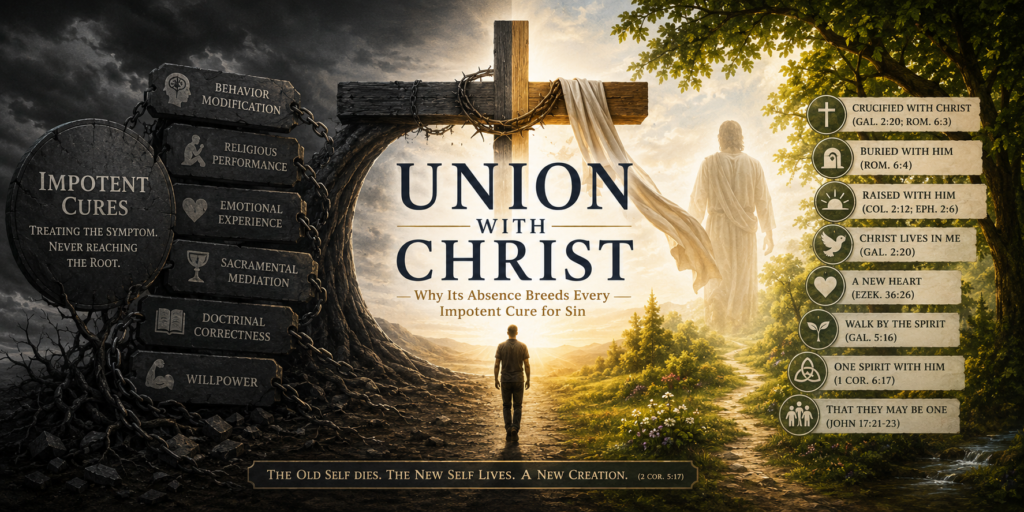
Why Its Absence Breeds Every Impotent Cure for Sin
There is a reason every generation of the church invents a new program for dealing with sin, and every generation eventually discovers that the new program does not work either. Accountability groups give way to spiritual disciplines, spiritual disciplines give way to recovery models, recovery models give way to therapeutic language borrowed from a culture that does not believe in sin at all. Each one promises what the last one promised. Each one quietly fails for the same reason.
They are all treating a symptom. None of them touches the root. And the reason none of them touches the root is that the church has, in large part, forgotten the one doctrine that actually reaches it: union with Christ.
When union disappears from a church’s working theology, sin does not become less of a problem — it becomes an unsolvable one, dressed up in solvable-sounding language. What fills the vacuum is not a cure. It is a long procession of impotent deceptions, each one trying to manage, suppress, or outperform a sinful nature that none of them has the authority to actually remove.
This matters more than it sounds like it should, because it determines what kind of cure is even possible. If the sin nature is a behavior, then behavior modification is a reasonable response — try harder, monitor more closely, surround yourself with better influences. If the sin nature is a headship — an inherited, structural condition, the heart of stone Ezekiel named (Ezekiel 36:26) — then no amount of behavior modification will touch it. You cannot discipline your way out of a nature you were born into. You need a new head. You need a new heart. Willpower was never going to be strong enough, because willpower was never the problem.
This is the first impotent deception: treating an ontological condition with a behavioral toolkit. It produces decades of sincere, exhausted people who have tried very hard to be good and cannot understand why the old patterns keep resurfacing. The patterns keep resurfacing because the source was never replaced. It was only ever managed.
What the Cross Actually Did
Paul’s answer to Adam is not improvement. It is execution.
The Greek vocabulary of Romans 6, Galatians 2, Colossians 2 and 3, and Ephesians 2 is built almost entirely out of compound verbs with the prefix syn — “with.” Crucified with Christ. Buried with him. Made alive together with him. Raised together with him. “Do you not know that all of us who have been baptized into Christ Jesus were baptized into his death?” (Romans 6:3). “We were buried therefore with him by baptism into death” (Romans 6:4). “I have been crucified with Christ. It is no longer I who live, but Christ who lives in me” (Galatians 2:20).
This is not devotional language. It is a description of what actually happened to the old self — Paul’s palaios anthropos — when a person comes into Christ. The old self is not rehabilitated. It is not gradually improved through religious effort. It is put to death, and it is buried, and a new life rises in its place — a life Paul describes as new creation (2 Corinthians 5:17), sourced entirely outside the self that died.
This is the only diagnosis-matching cure on offer anywhere in Scripture. Not management. Replacement.
The Sign and the Substance
Baptism is where this becomes visible. “As many of you as were baptized into Christ have put on Christ” (Galatians 3:27) — the language is incorporative, not merely symbolic. The water does not create the union; it declares and enacts what God has already accomplished in Christ’s own history. John’s baptism could only point toward this. Only the Spirit could actually enact it in a person.
This is why baptism, detached from what it signs, becomes its own small impotent deception — a rite performed correctly that substitutes for the death and resurrection it was always meant to display. The sign was never the substance. It was the substance’s visible grammar.
The Cure Has to Live Somewhere
Here is the most subtle counterfeit of all, because it can wear entirely orthodox clothing.
Everything above is positional — true of you the moment you are in Christ, settled at the cross, outside of time. But a settled fact and a lived reality are not automatically the same thing, and the bridge between them is the indwelling Spirit. “Christ lives in me” (Galatians 2:20). “Christ in you, the hope of glory” (Colossians 1:27). “He who is joined to the Lord becomes one spirit with him” (1 Corinthians 6:17).
Paul names the counterfeit directly in Galatians 3:3: “Having begun by the Spirit, are you now perfecting it by the flesh?” A person can receive the Spirit — the once-settled gift, the new heart coming alive — and then quietly slide back into self-effort for the daily living of it. Spiritual disciplines without the Spirit’s actual reliance. Religious performance dressed in the vocabulary of grace. White-knuckled holiness that looks like Christian maturity and runs on the same engine as the old self it claims to have buried.
This is the deception institutional Christianity is most prone to, because it does not deny union doctrinally. It simply stops relying on it functionally. The new heart is acknowledged in the creed and bypassed in the practice.
The Destination Was Never Just Sin-Removal
This is why the doctrine cannot be reduced to a solution for a problem. Jesus’ prayer in John 17 names something bigger than sin-management as the goal of the entire work: “that they may be one, even as we are one… I in them, and you in me, that they may become perfectly one” (John 17:21-23). The standard is not behavioral improvement. It is the relational life of the Trinity itself.
When union is forgotten, the church’s entire vision of the Christian life shrinks to fit what remains — sin avoided, sin confessed, sin managed, in an endless cycle with no larger horizon. When union is recovered, sin-removal is revealed as the doorway, not the destination. Union with the Father and the Son was the goal all along. Everything else was the road that gets you there.
A Doctrine the Church Buried, Not Lost
This is not a forgotten theory in need of invention. It is a forgotten center in need of recovery.
The early church held it without apology. Irenaeus and then Athanasius described salvation as participation in the divine life itself — Athanasius’s famous formula, that the Word “became man that we might become god,” was not poetic excess. It was the mainstream understanding of what the gospel accomplishes. The Greek East never let go of this. The Latin West, moving through Anselm and into medieval sacramental theology, gradually reorganized salvation around a legal ledger administered by an institution — guilt, merit, satisfaction — with union present but increasingly subordinate to the system dispensing it.
Even the Reformation’s clearest theologian of grace alone recovered union as the center rather than the periphery. Calvin opens Book Three of the Institutes by insisting that Christ’s entire work is worthless to us until he dwells within us and we are engrafted into him — union as the trunk every other benefit hangs from, not one benefit among several. Reformed scholasticism after him organized this into a tidy sequence of salvation-stages, and the trunk quietly became one stage among many again.
The pattern repeats because the underlying temptation never goes away: institutions can administer doctrines about Christ far more easily than they can administer participation in him. A ledger is manageable. A life hidden in God is not. So the manageable substitute keeps winning the institutional argument, generation after generation, while union keeps surviving — in the East, in Calvin’s own text, in renewal movements scattered across centuries — waiting to be un-buried again.
What This Means
Name the substitutes plainly, because they are still on offer everywhere: behavior modification dressed as discipleship. Religious performance dressed as devotion. Emotional experience dressed as transformation. Sacramental mediation dressed as grace. Doctrinal correctness dressed as faith. Willpower dressed as sanctification. Every one of them is an attempt to cancel a sinful nature that none of them has the authority to touch, because none of them goes near the place where the actual exchange happens — the old self crucified, buried, and replaced by a new heart inhabited by the Spirit of God.
Union with Christ is not one doctrine among many available for emphasis. It is the doctrine that makes every other cure unnecessary, and its absence is the reason the church keeps needing new ones.
The Diagnosis Has to Match the Disease
Scripture’s diagnosis of sin is not behavioral. It is genealogical. “As in Adam all die” (1 Corinthians 15:22) — not as in Adam some learned bad habits, but as in Adam, humanity itself was constituted under a fallen head. Romans 5:12-21 makes the same case at length: sin and death entered through one man, and the many were made sinners by union with him, not by individually replicating his choice.