Union, Purpose, and the Gathering of All Things in Christ
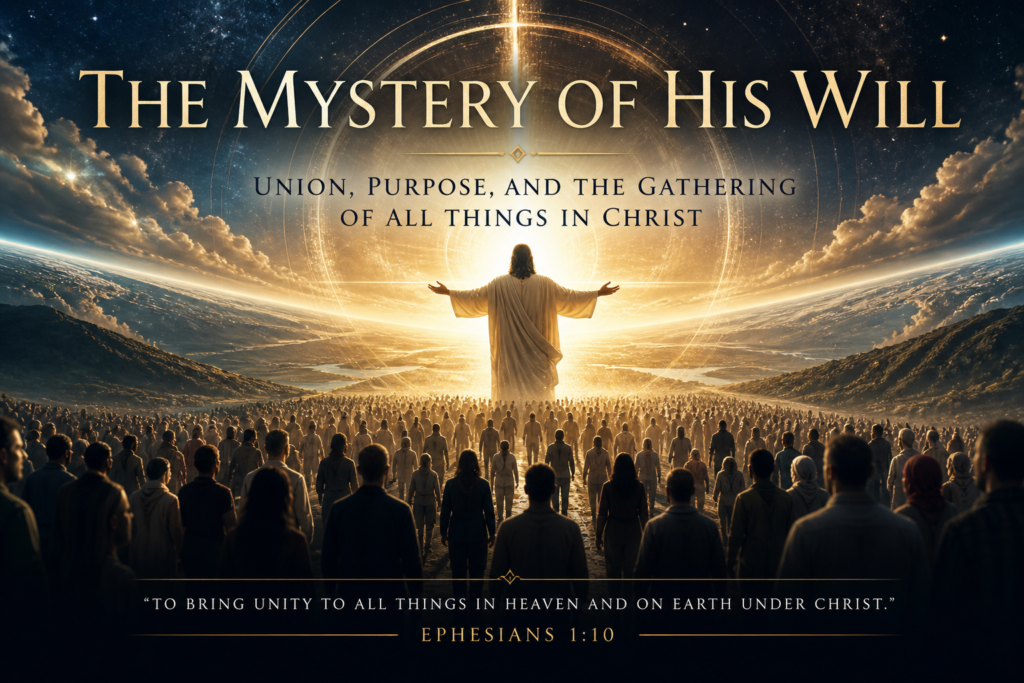
“In him we have redemption through his blood, the forgiveness of sins, in accordance with the riches of God’s grace that he lavished on us. With all wisdom and understanding, he made known to us the mystery of his will according to his good pleasure, which he purposed in Christ, to be put into effect when the times reach their fulfillment—to bring unity to all things in heaven and on earth under Christ.”
Ephesians 1:7–10 (NIV)
A Mystery Disclosed, Not Solved
The word mystery in Paul’s usage does not mean a puzzle awaiting solution. It means a hidden counsel, withheld by design and released by act. God did not conceal His will because it was unknowable. He concealed it because the fullness of time had not yet arrived. When that fullness came — in the Incarnation, death, resurrection, and gift of the Spirit — the mystery was not explained. It was disclosed. The disclosure itself is the event.
And the content of that mystery is breathtaking in its scope. Paul names it in verse 10: the anakephalaiōsis — the summing up, the recapitulating, the gathering of all things in Christ. Heaven and earth brought under one head. This is not a secondary implication of the gospel. It is the disclosed purpose of God, the end toward which all creation is moving.
Irenaeus and the Recapitulation
The second-century theologian Irenaeus of Lyon seized on this Pauline language and made it the organizing center of his theology. Against the Gnostics, who evacuated creation of meaning and reduced redemption to an escape from matter, Irenaeus insisted that Christ recapitulated — took up and retraced — the whole of human existence from the inside.
What Adam failed at each point, Christ redeemed by living it obediently. The disobedience through a tree answered by obedience on a tree. The fall of humanity in one man reversed by the faithfulness of the second Adam. And in his most compressed formulation, Irenaeus wrote that Christ became what we are so that we might become what He is.
This is not merely a theory of atonement. It is a cosmological claim. The fracture introduced by the fall — the severing of humanity from God, and of heaven from earth — is not repaired by a legal transaction. It is healed by incorporation. Christ as head draws all things into coherence under Himself. The anakephalaiōsis is the healing of cosmic disunity.
Unity: Not in Doctrine but in Him
The unity Paul describes in Ephesians 1:10 is not doctrinal consensus. Doctrinal unity is a human project — the alignment of propositions, the negotiation of formulations, the management of difference. It has produced centuries of councils, anathemas, and denominations. The more precisely a doctrinal standard is defined, the smaller the community that can inhabit it.
But Paul is describing something categorically different. The gathering is in Him and by Him. Christ is the gathering point, not a creed. The unity is ontological before it is confessional. The head draws the body into coherence not by issuing a standard but by being what He is. Two people genuinely in Christ do not construct unity between them — they encounter a unity that preceded their meeting. The Spirit recognizes Himself.
This is why institutional efforts at unity consistently fall short. You cannot organize people into the anakephalaiōsis. The chaos of disunity is not primarily a relational problem requiring better communication, or a theological problem requiring better formulation. It is a pneumatological problem. Where the Spirit genuinely indwells, the gathering is already happening. Where He is absent, no structural arrangement produces the reality.
Purpose: Not to Do but to Be
Notice the sequence Paul gives in Ephesians 1:7–10. Redemption comes first, then forgiveness, then grace lavished, then wisdom and understanding given — and only then the mystery disclosed. The cosmic purpose is not the starting assignment. It is the destination of a process that begins with the inner condition of the person being addressed.
This has profound implications for how we understand purpose. The dominant framework — inside the church and outside it — is fundamentally activist: purpose is what you produce, what you contribute, what you accomplish. Even when dressed in kingdom language, it reduces the person to a function.
But Paul’s sequence will not permit this. The election, adoption, redemption, and sealing of Ephesians 1 are all framed as what God has done to and in the believer, prior to any commission. Being precedes sending. The purpose is not a task assigned to a worker. It is a cosmic reality into which a transformed person is incorporated.
You do not accomplish the anakephalaiōsis. You become part of it. You are gathered into the One who is gathering all things. Purpose, properly understood, is participation in what Christ is already doing at cosmological scale — not a personal mission statement generated by self-assessment.
Why Union Is a Mystery
Union with Christ is mystery in the full Pauline sense. Not obscure or complicated, but hidden in God, disclosed in Christ, and receivable only by the Spirit.
You cannot arrive at union by human trajectory. Every path that reason, religion, and effort can build terminates somewhere short of it. The mind can formulate it. Doctrine can describe it. Worship can gesture toward it. But none of these are the thing itself. Union is entered, not achieved. Received, not constructed.
This is why the mystery remains hidden from those most energetically pursuing spiritual reality by other means. The Corinthians had gifts, manifestations, experiences — and Paul told them they were still infants, unable to receive what he had to give. Spiritual intensity does not unlock the mystery. The Spirit discloses it to those who have genuinely received Him.
And when He does, the individual discovery is simultaneously a cosmic event. The person genuinely in Christ is not merely saved — they are incorporated into the gathering. Heaven and earth overlap at the point of genuine indwelling. The anakephalaiōsis advances not by institutional program but by the Spirit doing in person after person what only He can do.
The Eschatological Destination
The unity of Ephesians 1:10 is the eschatological destination. But it is also the present experience of those who are genuinely in Him — not as achievement but as discovery.
The eschatological destination is simply this: everything in its right place under the right head. No negotiation. No management. No maintenance. Just the coherence that belongs to a creation properly ordered under Christ. The telos is not a state to be achieved by accumulated human effort. It is a Person drawing all things into Himself.
That simplicity is what makes it livable as present orientation. You do not have to carry the weight of fixing the fracture. You participate in the One who is already gathering. Your part is to be in Him.
This is purpose in its fullest sense — not what you do, but what you are in Christ, who is gathering all things. Everything else flows from that as expression, not as the thing itself.
“To bring unity to all things in heaven and on earth under Christ.”
Ephesians 1:10