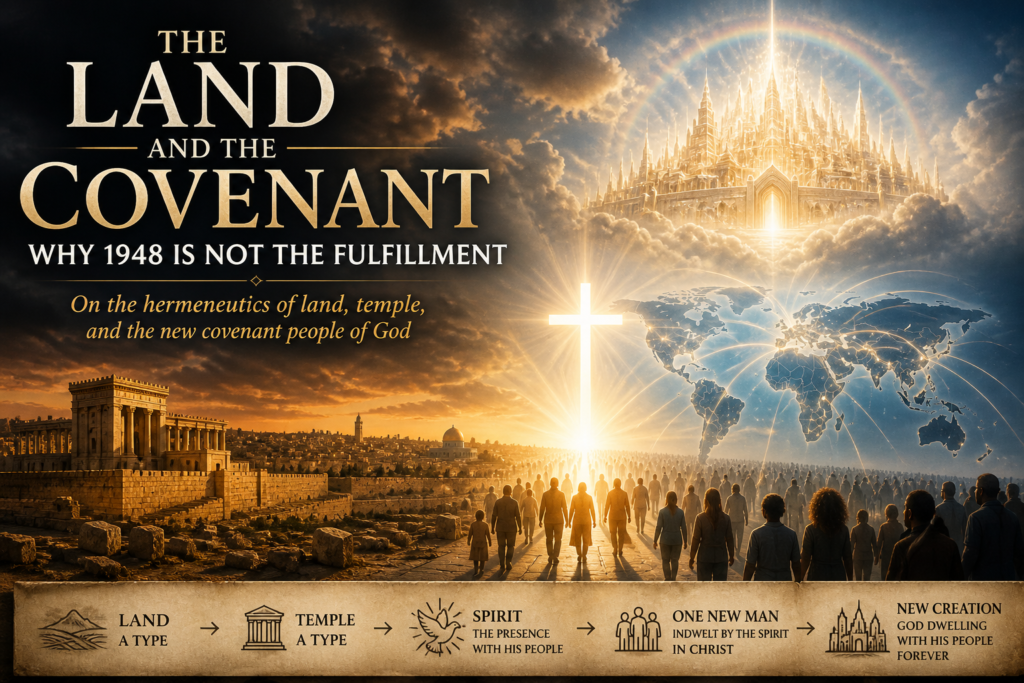
On the hermeneutics of land, temple, and the new covenant people of God
The claim that the modern state of Israel, established in 1948, constitutes the fulfillment of Old Testament prophecy concerning the ingathering of the nation is one of the most widely held convictions in contemporary evangelical Christianity. It is also, on close examination, one of the most theologically problematic. The objections are not peripheral. They strike at the covenantal architecture itself.
The Problem, Stated Plainly
- No miraculous change of heart among the returning people
- Continued national rejection of Jesus as Messiah
- A secular, politically-negotiated statehood with no covenantal framework
- No discernible distinction in the moral character of national life
These are not the observations of a hostile critic. They are the straightforward application of the prophetic texts themselves to the events in question. The question is whether those texts, read honestly within their canonical context, can bear the interpretive weight being placed upon them.
§ The Prophetic Ingathering Was Inseparable from Spiritual Renewal
The classical ingathering texts — Ezekiel 36–37, Deuteronomy 30, Jeremiah 31 — do not promise a return to the land as a standalone geopolitical event. They promise a return inseparable from a new heart, a new spirit, and the inner circumcision of covenant renewal. These are not two stages loosely associated. They are a single promise with two dimensions, and the spiritual dimension is not incidental — it is the point.
I will give you a new heart and put a new spirit in you; I will remove from you your heart of stone and give you a heart of flesh. And I will put my Spirit in you and move you to follow my decrees. — Ezekiel 36:26–27
The dispensationalist response is to posit a two-stage return: physical first, spiritual second, appealing to the structure of Ezekiel 37 — bones assembled before breath arrives. It is not a foolish reading in isolation. But it requires the physical stage to be identifiably supernatural and covenantally situated. A state produced by UN partition votes and military campaigns does not obviously qualify as a fulfillment of prophetic promise, even on its own terms.
More critically, the second stage — the breath, the Spirit, the new heart — requires, in the full canonical context, the recognition of Jesus as Messiah. A national return that explicitly and collectively excludes him cannot be the fulfillment of promises that find their Yes and Amen exclusively in him. Paul’s argument in 2 Corinthians 1:20 is not decorative. Every covenant promise is confirmed in Christ. A fulfillment that bypasses him is not a fulfillment — it is a different category entirely.
§ The Temple Problem Cannot Be Resolved
Christian Zionism requires, in its most consistent forms, a rebuilt temple with reinstituted sacrificial worship as part of the end-time scenario. This is where the theology runs into a wall it cannot get around honestly. The argument of the letter to the Hebrews is not that the Levitical system was suspended and awaits resumption. It is that the system was fulfilled and is therefore finished.
Unlike the other high priests, he does not need to offer sacrifices day after day… He sacrificed for their sins once for all when he offered himself. — Hebrews 7:27
A reinstituted sacrificial system does not complement the work of Christ. It contradicts the sufficiency of his high priestly offering. Dispensationalism handles this by designating millennial sacrifices as memorial — retrospective rather than propitiatory. But this is an enormous interpretive imposition on texts that say nothing of the kind, and it creates a theological category the Mosaic system itself never envisioned. The old covenant had no concept of a backward-looking sacrifice. Sacrifice was always transactional and forward-pointing. To retroactively redefine it as memorial in order to preserve the system after the cross is a workaround, not an exegesis.
§ The Land Was Always a Type, Never a Terminus
This is the hermeneutical key, and once grasped it reframes the entire discussion. The land was never the point. It was always the form the point took under the old covenant. The point was this: where does God dwell with his people? Under the old covenant that question had a geographical answer. Under the new covenant it has a personal and corporate answer — in Christ, by the Spirit, among the called-out community wherever they are gathered.
The covenant people are now the dwelling place. Which means the people are the land — in the only sense the new covenant recognizes.
The New Testament makes this move explicitly and repeatedly. The writer of Hebrews notes that Abraham, who possessed the land, treated it as a foreign country — because he was looking for a city whose builder and architect is God. The patriarch himself understood the promise as pointing beyond geography. Paul, in Romans 4, expands the land promise cosmologically: Abraham was to be heir not of Canaan but of the world. The trajectory is not geographical fulfillment — it is geographical transcendence.
John 4 is underappreciated in this discussion. When Jesus tells the Samaritan woman that the hour is coming — and now is — when true worshipers will worship neither on this mountain nor in Jerusalem, he is not describing a temporary displacement of worship. He is announcing a covenantal relocation. The entire land-centered worship architecture is being superseded in his own person. Worship is being moved from geography to Spirit and truth — not as a lesser arrangement but as the long-intended fulfillment of everything the geography was pointing toward.
§ Pentecost Reverses the Centripetal Logic of the Old Covenant
Under Moses, the logic of worship was centripetal: you went to the presence. Three times a year, every male in Israel was required to appear before the Lord in Jerusalem. The land and the temple were the fixed center, and the people moved toward them. This was not arbitrary — it was a theological statement about the localization of God’s presence under the old economy.
Pentecost reverses this logic entirely. Acts 2 begins in Jerusalem, but the Spirit immediately generates centrifugal momentum — outward to Judea, Samaria, and the ends of the earth. The presence no longer stays in one place while the people travel to it. The presence now travels with the people, indwelling them, moving through them into every nation. The center has shifted from a geography to a community, and from a community defined by ethnicity and land to a community defined by the Spirit.
A theology that tries to re-center covenant hope on a geographical parcel after Pentecost is not reading the movement of redemptive history — it is resisting it. It is attempting to re-insert a centripetal stage into what has become, irreversibly, a centrifugal mission.
§ Ephesians 2 and the One New Man
Paul’s argument in Ephesians 2 is the most direct canonical refutation of the framework that assigns Israel and the church to permanently separate covenantal tracks. The dividing wall of hostility — the very structure of old covenant separation between Jew and Gentile — has been abolished in Christ’s flesh. The two have been made one. The result is not two peoples with two distinct destinies running in parallel. It is one new man.
Christian Zionism must effectively suppress this text, or treat it as applying only to the church age as a parenthesis, after which the two-track structure is restored. But Ephesians does not present the one new man as a temporary arrangement. It presents it as the eternal purpose hidden in God from the ages — the mystery now disclosed. To reimpose the division after the cross is not prophecy. It is a reversal of the gospel itself.
§ The Canonical Endpoint Confirms the Reading
Revelation 21 does not describe a restored Israel occupying Canaan. It describes the new Jerusalem descending from heaven — God himself coming to dwell with his people. And in that city there is no temple, because the Lord God Almighty and the Lamb are its temple. Every element of the old covenant spatial architecture — land, city, temple, presence — has been absorbed into a person.
The endpoint of the canonical story is the cosmos becoming what the land always pointed toward: the dwelling place of God with his people, without mediation, without geography, without separation. The entire movement from Eden through Canaan through Zion through the incarnation through Pentecost through the new creation is a single coherent trajectory — God progressively closing the distance between himself and his people until the distance is gone entirely.
A theology that re-inserts a geographical and sacrificial stage into this trajectory after the cross is not honoring the Old Testament. It is freezing the Old Testament at its penultimate stage and refusing the fulfillment the New Testament announces. The shadows are being granted more substance than the reality that cast them.
§ Conclusion: The Right Question
The question is not ultimately whether the events of 1948 fulfill the specific conditions set by this or that prophetic text. The question is whether a geography-and-temple restoration is what the new covenant trajectory is even pointing toward. When the question is posed at that level, the answer the canon gives is clear and consistent from Abraham through Revelation: the land was a type, the temple was a type, and the new covenant reality that fulfills both is the people of God indwelt by the Spirit of God, gathered in the name of Christ, moving as his body into all the earth.
That is the ingathering the prophets were pointing toward. It began at Pentecost. It is still in motion. And it will be complete when the one new man, drawn from every tribe and tongue and people and nation, stands before the throne — not in Jerusalem, but in the city whose builder and architect is God.