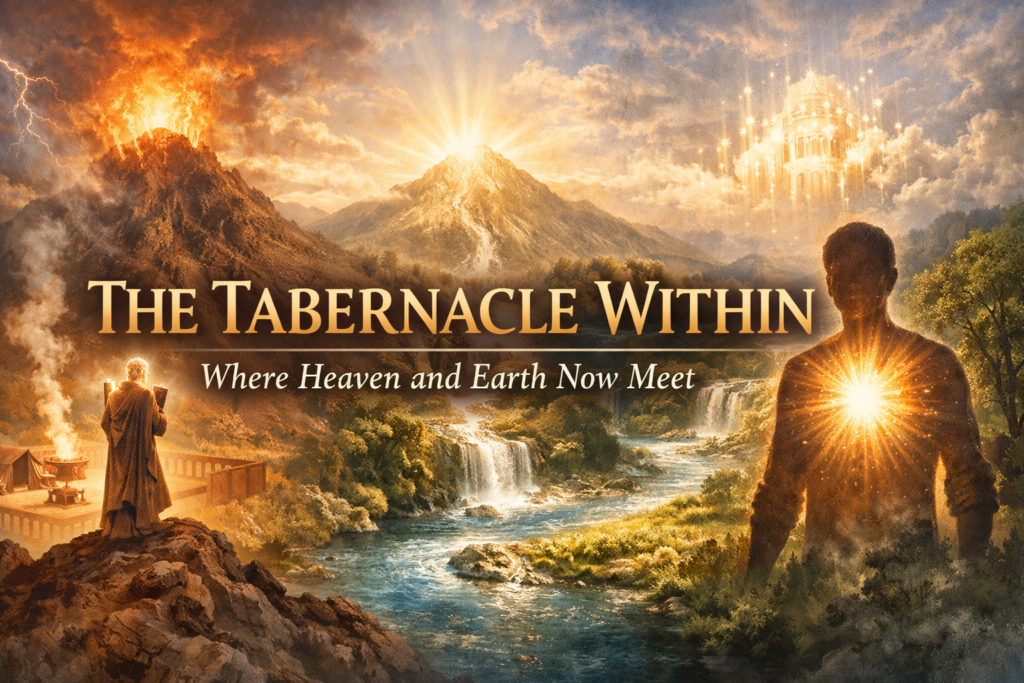
Where Heaven and Earth Now Meet
The Place Where God Dwells
From the beginning, the central question of Scripture has not been merely moral, historical, or even religious. It is architectural.
Where does God dwell—and how does man live with Him?
Creation itself is presented not simply as the making of a world, but as the forming of a dwelling place. God orders what was formless, separates what was indistinguishable, and establishes a realm where life can exist in harmony with His presence. The earth becomes a prepared space—not yet the fullness of His dwelling, but the stage upon which that dwelling will be revealed.
In Eden, that purpose comes into focus. This is not merely a garden; it is the first sanctuary. God walks with man. Life flows from a central source. The environment is ordered, alive, and open. There is no distance, no mediation, no barrier. Heaven and earth meet without obstruction.
But this union does not hold.
With the fall, man is not removed from the planet, but from the presence. Access is lost. The sanctuary remains, but the life within it is no longer shared. From that point forward, all of Scripture moves around a single question:
How will man return to the place where God dwells?
Eden: The First Sanctuary
Eden is the pattern from which everything else unfolds.
It is a place of life, but more importantly, it is a place of presence. God is not distant or abstract; He is near, relational, and engaged. The language used to describe His interaction with man is later echoed in descriptions of His presence in the tabernacle. What appears at first as simple narrative is, in fact, the introduction of a sanctuary.
The structure of Eden reinforces this. A river flows out from it, dividing into multiple streams that carry life outward. This detail is not incidental. Throughout Scripture, the presence of God is associated with a source from which life proceeds. Later prophets will describe water flowing from the temple. Revelation will speak of a river proceeding from the throne. The pattern begins here.
There is also evidence—subtle but consistent—that Eden is portrayed as an elevated place, a kind of “mountain of God.” Water flows outward, not inward. Later texts confirm this association. The presence of God is consistently linked with a place from which life descends.
Eden, then, is not merely the beginning of human life. It is the beginning of divine-human communion in a structured environment. It is the first tabernacle.
Exile and the Loss of Access
The fall does not destroy creation—it disrupts access.
Man is expelled, and the way back is guarded. The introduction of cherubim at the boundary of Eden is not symbolic decoration; it is a declaration. The place of life is now restricted. The presence of God is no longer freely accessible.
From this point forward, the problem is not distance in miles, but distance in nature.
Man continues to exist, to build, to think, to act—but he does so outside the immediate sharing of God’s life. The result is predictable: instability, corruption, fragmentation. The source has been lost, and everything downstream begins to reflect that absence.
Yet God does not abandon His purpose. Instead, He begins to reintroduce access—carefully, partially, and always with limitation.
Mountains, Men, and Mediated Presence
Throughout the Old Testament, God meets with man—but not in the open, universal way seen in Eden. Instead, access becomes localized, intensified, and mediated.
Mountains become the setting of encounter. Sinai stands as the clearest example. There, God descends in fire and cloud. The environment itself reflects the weight of His presence. Moses ascends and meets with Him, receiving law, instruction, and revelation. When he returns, his face shines with reflected glory.
But this encounter, while real, is not transferable.
The people do not share Moses’ experience. They observe from a distance. They fear the voice. They rely on the man who has gone up. The life he touches does not become their life. It remains external, mediated, and dependent.
The same pattern repeats in the tent of meeting. God speaks with Moses “face to face,” yet the interaction remains localized. The people wait. They follow. They respond—sometimes obediently, often rebelliously—but they do not participate in the same inner reality.
This reveals a fundamental limitation:
The life of God in one man cannot be transferred to others through proximity, instruction, or authority.
Hierarchy can transmit direction. It can enforce behavior. It can organize a people. But it cannot reproduce nature.
The Tabernacle: A Structured Eden
With the tabernacle, God establishes a formal system of access.
The design is deliberate. It echoes Eden in form and function. There is an outer court, a holy place, and an inner chamber—the Holy of Holies—where God’s presence dwells. Cherubim appear again, guarding the most sacred space. Access is restricted, controlled, and mediated through priests.
This is not the restoration of Eden. It is a regulated approximation.
The people are brought near—but not fully. They are included—but not indwelt. The system allows for interaction, but not union.
It also reveals something essential:
Even when God dwells among His people, without internal transformation the people do not become like Him.
The structure can host His presence, but it cannot reproduce His nature within them.
The Failure of Mediated Life
The history of Israel confirms what the structure already implied.
God raises leaders—Moses, Joshua, judges, prophets, kings—men who genuinely know Him and carry His authority. Through them, God speaks, acts, and guides His people.
And yet, the people do not become what these men are.
They follow, then wander. They obey, then rebel. Even under strong leadership, the pattern remains inconsistent. When the leader is removed, decline accelerates.
This is not primarily a leadership failure.
It is a structural limitation.
Mediated life cannot produce shared life.
The presence of God in a leader does not become the presence of God in the people. The best leadership can guide, restrain, and instruct—but it cannot internally transform.
This is why the Old Covenant, for all its glory, cannot complete what it begins.
The Promise of Internalization
The prophets begin to speak of something radically different.
No longer is the focus on improved structure or better leadership. Instead, the promise is internal:
- A new heart
- A new spirit
- The law written within
- God’s Spirit placed inside His people
This is not enhancement. It is replacement.
The problem is no longer addressed externally. It is addressed at the level of nature.
The imagery shifts as well. Water begins to flow from the temple, growing into a river that brings life wherever it goes. What was once contained begins to expand. What was once localized begins to spread.
The direction is clear:
The dwelling of God will no longer be confined—it will become internal and generative.
Christ: The True Meeting Place
Jesus does not merely participate in this system—He fulfills and replaces it.
He presents Himself as the temple. Not a structure, but a person. In Him, heaven and earth meet fully and without barrier. The presence of God is no longer contained in a place, but embodied in a life.
He does what the tabernacle could not do:
- He removes the barrier
- He fulfills the law
- He restores access
The tearing of the veil is not symbolic flourish. It is structural termination.
The system of mediated access is finished.
But more than access is restored. Something greater is introduced.
The Tabernacle Within
With the coming of the Spirit, the pattern completes its transformation.
The dwelling place of God is no longer external. It is internal.
The believer becomes the tabernacle.
This is not poetic language. It is the defining reality of the New Covenant. The presence that once descended now resides. The life that once had to be approached now indwells.
This changes everything.
No human being can function as a mediator of that life. No structure can contain it. No meeting can generate it. It is already present.
The question is no longer:
“Where do I go to meet God?”
But:
“Will I live from the God who is within me?”
One Flock, One Shepherd
With the indwelling established, the structure of authority is redefined.
Christ alone is Shepherd. All believers relate to Him directly. Leadership remains, but it no longer serves as a source of life or a necessary intermediary.
Like John the Baptist, true leadership decreases as Christ increases. It refuses to occupy a place that belongs to Him alone.
In a kingdom of priests, access is universal. The life once concentrated in a few is now present in all.
Hierarchy cannot transmit character. It never could. Now it is no longer needed to.
Why the Tabernacle Feels Broken
If the reality is so clear, why does the church often feel fragmented, dependent, and inconsistent?
Because the design has changed—but participation has not.
Believers are indwelt, but not consistently oriented to the indwelling. Awareness remains external. Habits remain inherited from systems that assume life must be mediated and reinforced.
As a result, structures compensate.
Meetings attempt to generate what should already be present. Leaders carry weight they were never meant to bear. People rely on external clarity rather than internal life.
The result is a clumsy expression of what should be organic.
The problem is not the design—it is the misalignment.
Realignment: Living from Within
The solution is not new systems, better leadership, or refined methods.
It is a return to the actual source.
Living from the indwelling requires:
- reoriented attention
- developed sensitivity
- distinction between soul and Spirit
- willingness to trust the presence within
It also requires releasing unnecessary dependence on external structures as sources of life.
The body remains essential—but not as supply. As expression.
Oneness does not come from agreement among many voices, but from shared alignment to one indwelling Christ. Like instruments tuned to a single reference, harmony emerges not by effort, but by alignment.
The Dwelling Restored
The story comes full circle.
What began in Eden as open communion is not merely restored—it is expanded. The dwelling place of God is no longer a garden, a mountain, or a structure. It is a people.
Heaven and earth meet again—but now within.
The question that remains is not theological, but practical:
Will we continue to live as though access must be mediated, or will we step fully into the reality that the tabernacle has already been established within us?
Everything depends on the answer.