From Tent to Indwelling: The Mission of God in a Moving People
There is a thread that runs from the wilderness to the present reality of the ekklesia—a thread often seen in parts but rarely held together.
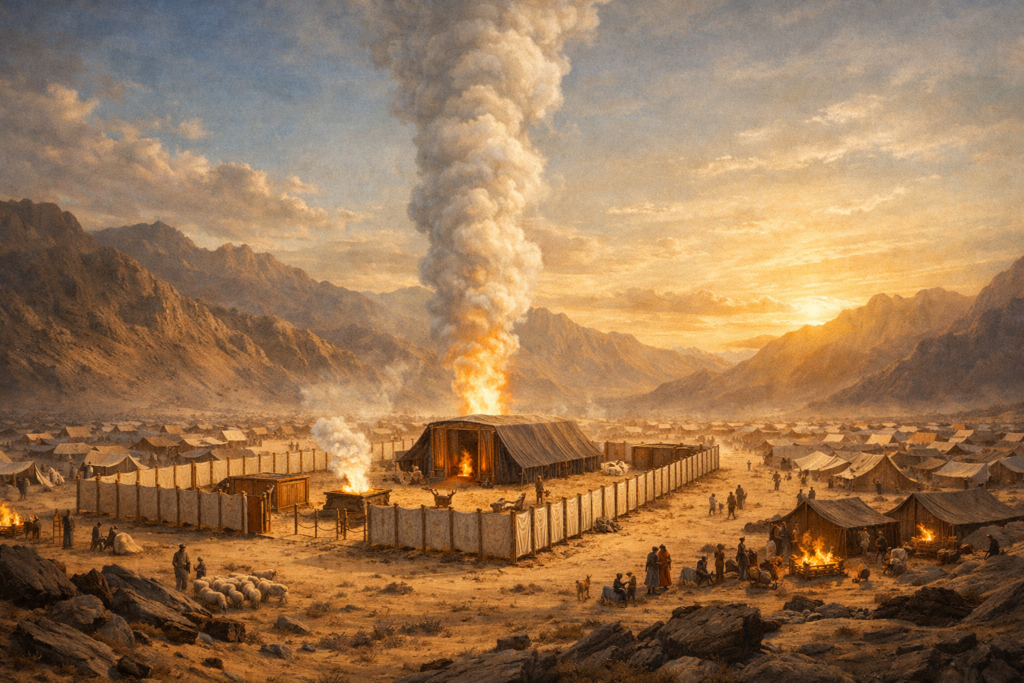
In the wilderness, God chose to dwell among His people in a tent.
The Tabernacle was not merely a place of worship. It was a statement:
God would not remain distant.
He would dwell among a people in motion.
This dwelling was not fixed. It moved when the cloud moved. It rested when the cloud rested. The life of the people was ordered not around a system, but around a Presence.
Everything about the tabernacle reinforced this:
- It was self-contained—all that was required for approach, cleansing, light, and communion was within it.
- It was portable—carried on the shoulders of men, never rooted to the ground.
- It was central—the tribes arranged around it, not it around them.
It was a dwelling designed for a people who had not yet arrived.
THE SHIFT TO STABILITY
When the kingdom was established under David and brought to rest under Solomon, the tent gave way to a structure.
The Solomon’s Temple represented something real and necessary: the enthronement of God among a people in a settled land.
No longer moving.
No longer carried.
Now fixed, elevated, and centralized.
The temple revealed the weight of glory in a way the tabernacle did not. It magnified holiness, order, and permanence. But it also introduced a subtle shift:
The people no longer moved with the dwelling.
They came to it.
Over time, what had once been centered on the Presence became attached to the place.
THE COLLAPSE OF EXTERNALIZED DWELLING
In the fullness of time, God did not restore the tabernacle nor merely purify the temple.
He embodied the dwelling.
In Christ, the entire system converged. The presence of God was no longer housed in a structure, whether mobile or fixed, but in a Person.
At the cross, the decisive break occurred. At the Crucifixion of Jesus, the veil was torn—not improved, not expanded, but removed.
The architecture of distance ended.
The dwelling of God was no longer external to man.
THE DISTRIBUTED DWELLING
What was once singular in Christ became multiplied in His people.
The ekklesia is not a new version of the temple as a structure. It is the continuation of the dwelling as life.
Believers are described as:
- “living stones”
- “a dwelling of God in the Spirit”
- those in whom Christ Himself lives
This is not metaphor layered onto an unchanged system. It is a shift in ontology.
The dwelling is no longer:
- carried on poles
- built with hands
- localized in a city
It is now:
- indwelling
- distributed
- mobile in every direction
The tent has not been replaced by a better building.
It has been fulfilled in a living people.
THE IRONY OF OUR MOMENT
And yet, something feels off.
If the same Spirit indwells every believer, why does the expression of that life feel fragmented? Why does the ekklesia often lack the coherence one would expect from a shared source?
The problem is not in the design.
The life of Christ within His people is whole, immediate, and sufficient. Nothing is lacking in the dwelling itself.
The problem lies in participation.
We have been given a shared life, but we do not consistently live from that life—together.
Instead, we operate from mixed sources:
- the indwelling Christ
- learned independence
- externalized systems
- inherited patterns of control and performance
The result is not the absence of life, but the uneven manifestation of it.
What should be a unified expression becomes clumsy and fragmented—not because the Spirit is divided, but because the people are not aligned in what they draw from.
HOSPITALITY TO THE INDWELLING CHRIST
At the heart of this misalignment is a subtle but profound issue: we do not consistently live in yielded dependence upon the One who dwells within us.
To speak of “hospitality” to Christ within is not to suggest effortful attentiveness or spiritual performance. It is to describe a posture:
- trust rather than self-initiation
- yielding rather than control
- dependence rather than management
When believers live from different functional sources, unity cannot manifest, even if it is already true in essence.
Division, then, is not the failure of God to make us one.
It is the persistence of independence within a people who have already been joined to the same Life.
THE MISSION CONTINUES
We are not waiting to become the dwelling of God.
We are learning to live as those in whom He already dwells.
In this sense, we remain in a “mission phase”—but not as those building a house for God. Rather, as those through whom God is expressing His life into the world.
The mobility of the tabernacle finds its fulfillment here:
Not in a tent moving through the wilderness,
but in a people carrying the presence wherever they go.
The dwelling has become mobile again—but now from within.
TOWARD A COHERENT PEOPLE
What, then, would it look like for the ekklesia to function in alignment with this reality?
Not a better structure.
Not a refined system.
Not improved execution of a blueprint.
But a people:
- inwardly anchored in the same indwelling Life
- outwardly responsive to that Life together
- free from the need to manufacture what has already been given
The goal is not perfection of form, but clarity of source.
As this alignment increases, something begins to emerge:
- less fragmentation
- less performance
- more simplicity
- more coherence
Not because the design has changed, but because the people are beginning to live from it.
A FINAL ORIENTATION
The tabernacle revealed a God who moves with His people.
The temple revealed a God enthroned among His people.
Christ revealed God embodied.
The ekklesia reveals God indwelling.
The question before us is no longer:
Where does God dwell?
But:
From where are we living?