The Problem Beneath Our Sins
Humanity’s problem runs deeper than the individual acts we call sins. Scripture certainly recognizes those acts—Paul writes that Christ “was delivered up for our trespasses” (Romans 4:25)—but the biblical diagnosis goes further. Jesus Himself teaches that sin originates from the heart: “Out of the heart come evil thoughts, murder, adultery, sexual immorality, theft, false witness, slander” (Matthew 15:19). The problem, therefore, is not merely a record of wrongdoing but a misdirected inner life. The heart—the center of desire, love, and orientation—has become bent away from God. From this distorted center flows the stream of sins that fills human history. The outward acts are real, but they are symptoms of a deeper condition. Long before the coming of Christ, the prophets recognized this. God promised through Ezekiel not merely forgiveness but renewal of the inner person: “I will give you a new heart and put a new spirit within you… and I will put my Spirit within you and cause you to walk in my statutes” (Ezekiel 36:26–27). The gospel must therefore address both problems: the guilt of our sins and the deeper condition that produces them.
The Cross and the Forgiveness of Trespasses
Paul begins by addressing the first problem when he writes that Christ “was delivered up for our trespasses” (Romans 4:25). The word trespasses appears in the plural, pointing to the many acts of sin committed by human beings. These acts carry real guilt before God, and the cross deals with them decisively. Through Christ’s sacrifice, the burden of those sins is removed. The Old Testament anticipated this through the Day of Atonement described in Leviticus 16. On that day two goats were presented before the Lord. One goat was sacrificed, its blood making atonement for the people. The second goat—the scapegoat—symbolically carried the sins of the people away into the wilderness. Together these two actions portrayed the full meaning of atonement: sin must be dealt with before God, and sin must also be removed from the people. John the Baptist recognized the fulfillment of this imagery when he declared of Jesus, “Behold, the Lamb of God who takes away the sin of the world” (John 1:29). At the cross our trespasses are forgiven, yet forgiveness alone does not solve the deeper problem.
The Deeper Problem: The Source of Sin
The real issue lies beneath the individual acts of sin. Humanity possesses an inner orientation that continually produces those acts. If the outward sins are branches, the inward condition is the root. Scripture describes this old orientation as the “old self.” Paul explains that “our old self was crucified with Him so that the body ruled by sin might be rendered powerless” (Romans 6:6). In other words, the cross does more than forgive sins; it brings about the death of the life that produced them. Humanity had become, in a sense, a kind of sin factory, generating disobedience as its natural output. The cross represents the shutdown of that factory. The old order of life organized around independence from God is brought to an end. This is why the New Testament repeatedly speaks of believers as having died with Christ. The cross is not only about pardon; it is about the end of the old humanity.
Raised for Our Justification
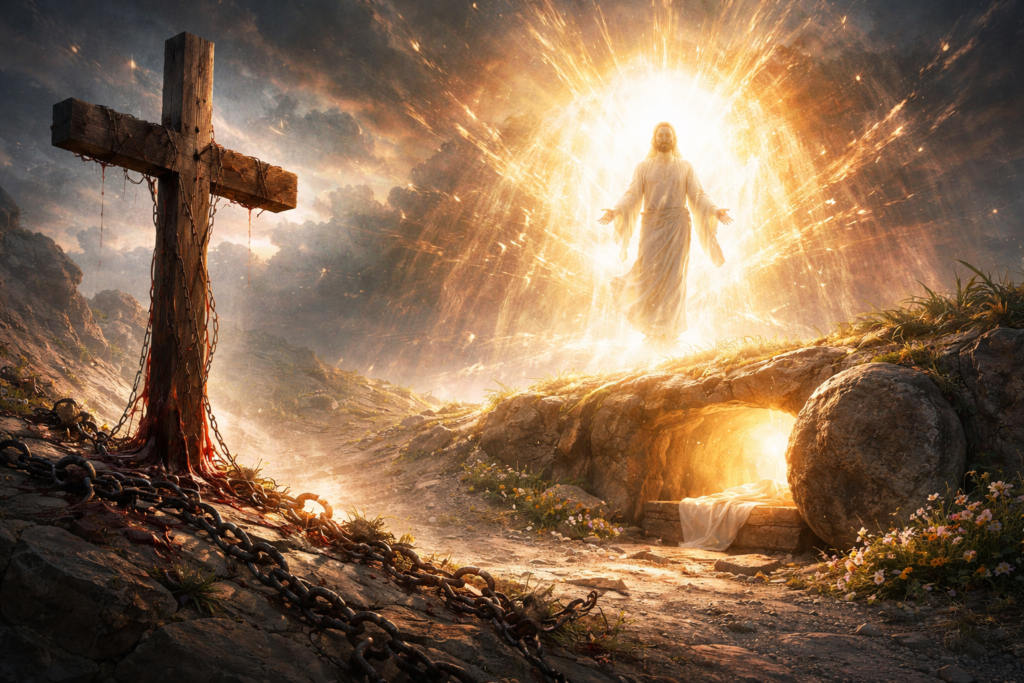
Paul completes the thought by saying that Christ was “raised for our justification” (Romans 4:25). Resurrection is not merely proof that the cross worked. Resurrection is life emerging from death. It marks the beginning of the new creation. Paul explains this elsewhere when he writes that “just as Christ was raised from the dead… we too might walk in newness of life” (Romans 6:4). Through union with Him believers enter a new reality. “If anyone is in Christ,” Paul says, “he is a new creation” (2 Corinthians 5:17). The resurrection introduces a new order of life. The old life that produced sin has died with Christ, and a new life begins in Him.
Perfected Yet Being Sanctified
The writer of Hebrews captures the tension between what Christ has accomplished and what believers are still learning to live out when he writes, “By one sacrifice he has perfected forever those who are being sanctified” (Hebrews 10:14). Two realities appear together in this statement. Through Christ’s sacrifice believers have been perfected. Yet they are also in the process of being sanctified. The perfection refers to what Christ has accomplished; sanctification describes the Spirit’s ongoing work of teaching believers how to live from that new life. Something decisive has already happened, yet believers must still grow into that reality.
Why Paul Could Call Immature Believers “Saints”
This helps explain why Paul could address troubled churches like the Corinthians as “saints” (1 Corinthians 1:2) even though their behavior was immature. Their identity in Christ had already been established, even though their conduct had not yet caught up to that reality. Paul therefore repeatedly asks them, “Do you not know…?” (1 Corinthians 6:19). He is reminding them of what is already true. They belong to Christ. They are temples of the Holy Spirit. The problem is not that these realities are absent, but that they have not yet learned to live from them.
Already Complete in Christ
For this reason the apostles continually remind believers that they already possess everything necessary for life with God. Peter writes that God’s divine power “has given us everything we need for life and godliness” (2 Peter 1:3). Likewise Paul says, “In Him you have been made complete” (Colossians 2:10). These statements do not deny the need for growth. Rather, they affirm that the source of life has already been given. The Christian life is not a quest to obtain something missing but a process of learning to live from what has already been provided in Christ.
Learning to Walk by Faith
Because this way of life is unfamiliar, believers must learn how to walk in it. Humanity has been trained to rely on sight, effort, and self-direction. Faith operates differently. Paul therefore writes, “We walk by faith, not by sight” (2 Corinthians 5:7). Walking implies movement, practice, and learning. Just as a child must learn to walk after receiving life, believers must learn how to live from the life of Christ within them. This is the work of discipleship. The Spirit trains believers to trust the new life that has been given rather than reverting to the patterns of the old.
The Full Scope of the Gospel
When all these themes are brought together, the full scope of the gospel becomes clear. Through the cross our trespasses are forgiven. Through union with Christ’s death the old source of sin is brought to an end. Through the resurrection believers enter the life of the new creation. Through the Spirit believers learn to walk in that life by faith. The gospel therefore does more than pardon sinners. It restores the human person to life with God. Forgiveness clears the ground, the cross ends the old life, the resurrection begins the new one, and discipleship teaches us how to walk in it.