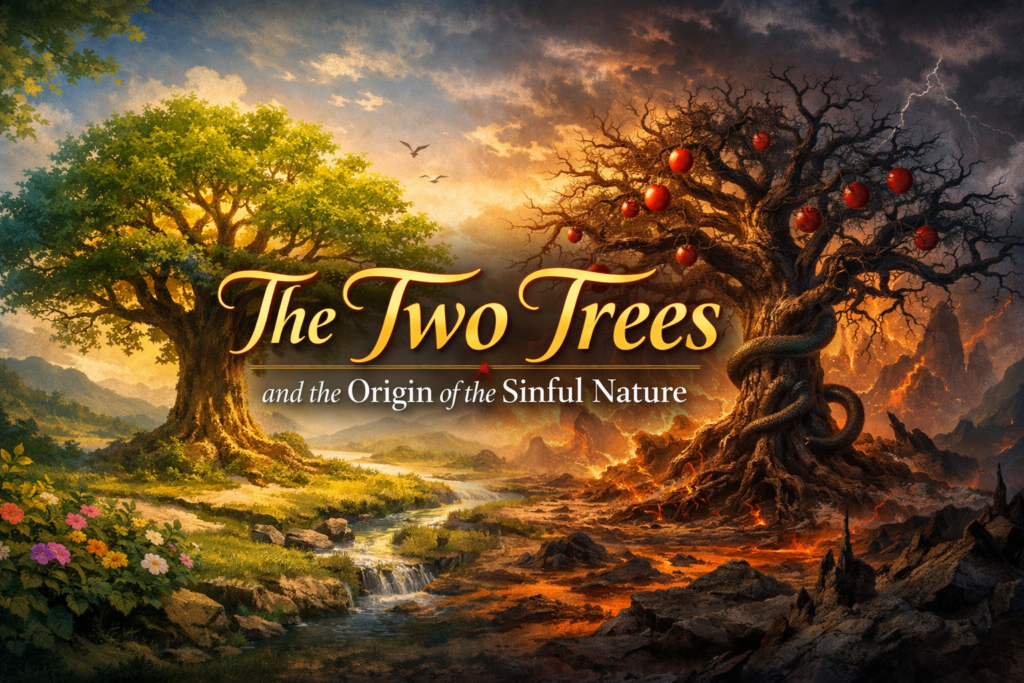
“The Lord God commanded the man, saying, ‘You may surely eat of every tree of the garden, but of the tree of the knowledge of good and evil you shall not eat…’” Genesis 2:16–17
Two Trees, Two Sources of Life
The story of the human condition does not begin at Sinai, nor in Israel’s history, nor in the moral struggles of humanity. It begins beneath two trees placed side by side in Eden. One tree offered life by dependence; the other offered death through independence. These trees are not relics of an ancient garden. They represent two spiritual realities that govern the whole of Scripture and the whole of humanity.
One is the atmosphere of the Spirit.
The other is the atmosphere of the self.
One produces communion.
The other produces what Scripture calls the sinful nature.
The Choice for Independence
When Adam and Eve ate from the tree of the knowledge of good and evil, they were not reaching for immorality. They were reaching for autonomy. They wanted the capacity to navigate right and wrong without God as their source.
What changed that day was not merely human behavior but the inner posture of the human heart: a shift from union to independence, from receiving life to defining life, from reliance to self-reliance. That inward shift—self at the center—is the essence of the sinful nature.
Death as Separation, Not Inactivity
The tragedy of the fall was not only the entrance of sin into the world but the loss of shared life with God. Scripture says humanity became dead, and that death was not inactivity but separation.
A person can be morally ambitious, religiously sincere, spiritually curious, and still utterly dead in the biblical sense—cut off from divine life. The sinful nature is not simply the impulse to do wrong; it is the drive to be right without God. It is the self attempting to live, discern, and act apart from union.
The Inner Law Before Sinai
Genesis reveals that the moment humanity ate of that tree, an inner law took root. Humanity became “under law” long before Moses ever climbed Sinai. After the fall, people lived with an internalized knowledge of good and evil—yet without the life to fulfill it.
What Adam embraced in the garden became the inheritance of the human race:
moral awareness without spiritual power,
conscience without communion,
standard without life.
The law given later did not create this condition—it exposed it.
Why the Law Intensified Sin
This is why Paul could write, “When the commandment came, sin sprang to life and I died” (Romans 7:9). The law did not corrupt humanity; humanity was already corrupted by independence. The law intensified what the tree of knowledge had already begun.
Paul goes so far as to say, “The power of sin is the law” (1 Corinthians 15:56). Why? Because the law confronts a morally awakened humanity that cannot produce the righteousness it knows it ought to have.
The tree awakened desire for righteousness—without the ability to live it.
The law amplified that impotence.
The Universal Result of Independence
The outcome is universal and unavoidable:
- The law demanded perfection but gave no life.
- The tree promised moral discernment but offered no union.
- Both left humanity condemned to independence.
Why the Sinful Nature Must Die
This is why death is the only escape from the sinful nature. The problem is not occasional rebellion but a state of existence rooted in self-rule. The sinful nature cannot be trained, managed, or improved. It must die.
The cross is not merely forgiveness. It is execution—the execution of the independent self-life that originated at the tree of knowledge. Only death with Christ can free a person from the internal law of independence. Moral striving could never accomplish this.
The cross does what effort cannot: it dissolves the old union.
The Tree of Life and the Order of Union
In contrast, the Tree of Life represents a completely different order—the order of union. It is not knowledge about good and evil but the life of God flowing into humanity.
Jesus identifies Himself with this tree when He says,
“I am the Vine; you are the branches… apart from Me you can do nothing.”
This is not poetic sentiment. A branch has no independent life. It lives only because the Vine lives.
New Covenant Life: A New Source, Not Better Tools
Under the New Covenant, believers are not given better moral tools; they are grafted into a new source. The Spirit is not a helper to the old self but its replacement.
Scripture calls this newness of life. And life here is not a feeling or a metaphor—it is Christ Himself living in us by the Spirit.
Where the law supplied knowledge without power, the Spirit supplies life.
Two Spiritual Environments
Scripture contrasts:
- “the law of sin and death”
- with “the law of the Spirit of life” (Romans 8:2)
These are not abstract religious phrases. They describe two spiritual ecosystems:
- the atmosphere of independence
- the atmosphere of union
Resurrection From the Inside Out
This inner resurrection occurs when the Spirit who raised Jesus from the dead enters the graveyard of the human heart and breathes life.
What Adam lost, Christ restores.
What the tree of knowledge corrupted, the Spirit resurrects.
What the law condemned, the cross ends.
God does not rehabilitate the old inheritance. He replaces it.
The Tree of Life Now Within
The Tree of Life is now within.
The Vine abides in the branch.
The Spirit becomes the oxygen of the new creation.
The Cross Between the Two Trees
The story that began with two trees turns at a cross that stands between them. At that cross, the tree of knowledge completes its work—death. At the same cross, the Tree of Life begins its work—resurrection.
The sinful nature is not a psychological tendency or personality pattern. It is a spiritual inheritance from the wrong tree.
The new nature is not a moral upgrade. It is a spiritual impartation from the right Tree—Christ Himself.
Seeing the Trees Clearly
To understand the sinful nature, you must understand independence.
To understand holiness, you must understand union.
To understand the Christian life, you must see the trees.
Why the Spirit Is Indispensable
This is why the gift of the Spirit is indispensable. He alone uproots the dominion of the tree of knowledge and plants us into the Tree of Life. He alone makes possible what the law could never accomplish—righteousness born from shared life rather than independent effort.
With this foundation in place, we now turn to the mystery that makes all transformation possible: the precious and essential gift of the Holy Spirit, who applies everything Christ accomplished and becomes the very life of the believer.