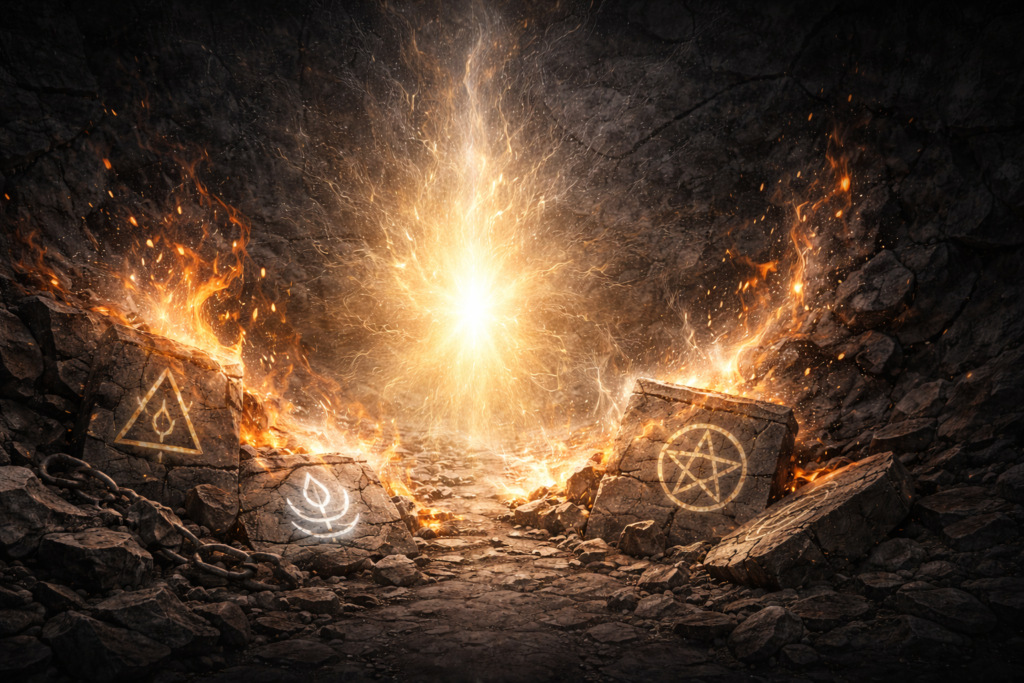
Elemental Transformation vs. Death and Rebirth — Beasts vs. Sons of God
Life Replaced by Technique
Christianity did not lose its power because believers stopped trying. It lost power because life was quietly replaced with technique. When the indwelling life of God is no longer trusted as sufficient, religion instinctively reaches for substitutes. Discipline replaces dependence. Methods replace life. Principles replace presence. What Scripture presents as death and rebirth is gradually reinterpreted as improvement, training, and management of the self.
At that point, life is no longer lived directly from union with God but is mediated—that is, expected to arrive through something external that stands between the person and God as the operative source. Guidance, obedience, and transformation are no longer drawn from indwelling life but delivered through structures, processes, or techniques that claim to help produce what only life can supply.
Elemental Thinking: The Shared Assumption
Behind both ancient philosophy and modern religion lies a common assumption: the same underlying material remains and only needs adjustment. Change, under this view, is achieved by restraint, refinement, discipline, or method. The source of life is rarely questioned; only the structure governing behavior is addressed.
Scripture gives this assumption a name. It belongs to what the New Testament calls στοιχεῖα (stoicheia)—the elemental principles, foundational frameworks, and ordered systems that govern life when it is not animated from within by the Spirit. These systems do not exist to impart life but to regulate it. They function precisely by mediation: life is expected to come through instruction, structure, or discipline rather than from indwelling union.
Stoicism: Training the Old Man
Stoicism is one expression of elemental thinking. It seeks virtue through mastery of the will, restraint of desire, and control of impulse. At first glance, it resembles holiness. It produces seriousness, resolve, and self-control. Yet it never questions the source of life. The self remains intact, merely governed.
In this way, stoicism mediates life through the disciplined will. Obedience is not expected to flow from shared nature, but to be produced by restraint and resolve. In biblical terms, stoicism attempts to train the old man. Scripture never instructs this. The old man is not described as undisciplined, but as dead. Stoicism restrains behavior without replacing desire. It governs strength without changing nature. A restrained beast is still a beast.
Alchemy: Improving the Old Man
Alchemy represents the hopeful twin of stoicism. Where stoicism says, control what you are, alchemy says, transform what you are—through knowledge, process, or technique. Applied spiritually, it assumes that human nature can be changed by disciplines, habits, principles, systems, or programs.
Here life is mediated through process. Transformation is expected to arrive by faithfully applying the right steps over time. God may be acknowledged as the goal of the process, but the process itself becomes the functional source of change. This explains why Christianity so often speaks the language of keys, steps, takeaways, and methods. Change is expected to occur through procedure rather than through death and rebirth. But Scripture never teaches the refinement of Adam. Alchemy promises a new nature without a new birth. It offers transformation without crucifixion.
The Scriptural Verdict: The Old Man Must Die
The New Testament speaks with striking clarity on this point. The old man is not disciplined, educated, repaired, or refined. He is crucified, put off, buried, and replaced. “You died” is not metaphorical encouragement; it is ontological declaration. “New creation” does not mean improved creation.
Christianity does not teach elemental transformation of human nature. It teaches death and rebirth. Any system that mediates life—however sincere, moral, or well-intended—necessarily preserves the very self the cross brings to an end.
“The Elements Will Burn”: What Peter Is Saying
This brings clarity to Peter’s often-misunderstood words that “the elements will burn.” In 2 Peter 3, Peter is not offering a lesson in physics or predicting the annihilation of matter. The Greek word translated “elements” is stoicheia, the same word Paul uses to describe religious frameworks, governing principles, and ordered systems that structure life apart from the Spirit.
These systems exist precisely because life is mediated rather than indwelling. They organize obedience, transmit instruction, and manage behavior where life does not yet flow from within. Peter does not say these systems will be corrected, upgraded, or repurposed. He says they dissolve. Fire exposes that what once governed life externally cannot survive the presence of life internally. What remains is not improved structure, but new creation in which righteousness dwells.
Beasts and Sons: Two Ways of Living
Scripture often contrasts managed existence with sonship. Beasts live by instinct, strength, and survival. They can be trained, restrained, and made useful, but they do not share the father’s nature. Sons do.
Sons do not live by mediated systems. They live by participation. Obedience flows not from restraint or process, but from shared life. Holiness is not imposed upon them; it emerges from within. Beasts must be managed. Sons must be nourished.
What Remains When the Fire Finishes
When the stoicheia burn—when systems of discipline, improvement, and instruction collapse—what remains is not chaos. What remains is Christ indwelling, the Spirit leading, righteousness dwelling, and obedience flowing from life.
This is why Peter does not ask what people should do, but what kind of people they ought to be. The question is ontological. It cannot be answered by willpower, method, or principle. It can only be answered by new birth.
A Quiet Diagnostic Word
If transformation in a person’s life depends primarily on structure, accountability, resolve, or technique, then life is being mediated rather than lived. This is not condemnation; it is an invitation. God does not refine the old creation. He replaces it.
And what emerges are not trained beasts, but sons of God, sharing His life, expressing His nature, and living from within what no fire can consume.