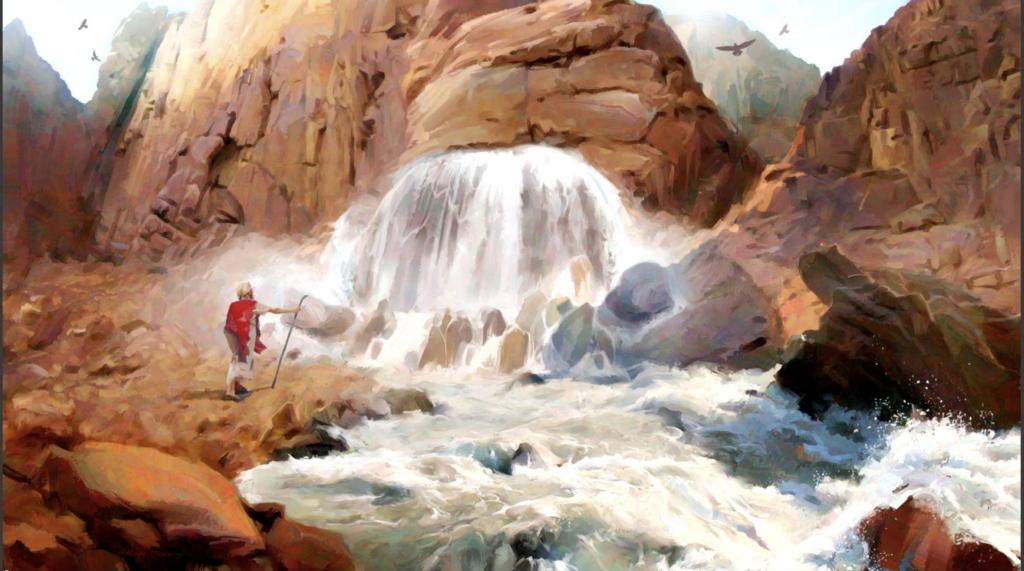
In the wilderness of Sinai, Israel faced a crisis that exposed more than physical thirst. Stripped of familiarity, security, and control, the people quarreled with Moses and tested the LORD, asking the revealing question: “Is the LORD among us or not?” (Exod. 17:7). What followed was not merely a miracle of provision, but a carefully staged revelation of the gospel—one that reaches forward to the cross with startling clarity.
God’s instructions to Moses are precise:
“I will stand by the rock at Horeb. And you shall strike the rock, and water will come out of it for the people to drink.”
— Exodus 17:6 (NIV)
This single sentence contains a depth of theological meaning often missed by casual reading. The issue is not simply that water comes from a rock, but where God places Himself when the rock is struck.
God’s Deliberate Positioning
The Hebrew preposition translated “by” (ʿal) carries a range of meanings—on, upon, over, against, beside. The NIV’s “by” is faithful, and importantly, it does not imply distance. God is not acting remotely. He locates His presence at the rock, making it the focal point of covenantal action.
In Scripture, when God “stands” somewhere, it signals judicial and covenantal engagement. He stands to contend, to testify, to judge, or to save. At Horeb, God does not stand with the accusing people, nor does He stand apart as a detached observer. He stands by the rock—the very object that will receive the blow.
This is not incidental staging. It is redemptive choreography.
The Rock Identified
The New Testament does not leave the identity of the rock to speculation. Paul states it directly:
“They drank from the spiritual Rock that accompanied them, and that Rock was Christ.”
— 1 Corinthians 10:4
The Rock is identified as Jesus Christ. That apostolic interpretation retroactively illuminates Exodus 17. The scene is not merely about Moses and Israel; it is about Christ, present in type long before the incarnation.
When God says, “I will stand by the rock,” He is declaring—in shadow form—that He will be present with Christ at the point where judgment falls.
The Elders as Witnesses
God commands Moses to bring the elders of Israel. These are not passive details. The elders represent the covenantal leadership of the nation. They do not strike the rock themselves; they witness it. Their presence establishes corporate accountability and public confirmation.
This becomes haunting in the light of the Gospels. The elders of Israel would later stand again as witnesses—this time not to a type, but to the reality. They would formally condemn Christ and deliver Him to be crucified. The same covenantal representatives who once watched the rock struck in the wilderness now ensured the striking of the true Rock in Jerusalem.
The pattern is consistent.
The witnesses are present.
The judgment falls.
The people live.
The Will to Crush
Isaiah removes any remaining ambiguity:
“It was the LORD’s will to crush Him and cause Him to suffer.”
— Isaiah 53:10
This statement has unsettled many, but it should not be softened. It does not speak of cruelty, but of covenantal resolve. The Father is not distant at the cross. He is not reluctant. He is not surprised. He is acting according to redemptive will.
Just as God stood by the rock at Horeb, He stood with the Son at Calvary.
This preserves essential biblical truth:
- The Father is not the Son
- The Son is not an accidental victim
- The cross is not divine indifference
- Judgment is not denied
- Mercy is not sentimentalized
The Father wills the crushing of the Son so that life may flow to the people.
The Strike and the Water
The rod Moses carries is the same rod of judgment used in Egypt. It is not a symbol of persuasion, but of authority. When the rock is struck, judgment is enacted—not on the guilty people, but on the object God has identified with Himself.
Only after the striking does the water flow.
In Scripture, water consistently signifies life, cleansing, and divine indwelling. Jesus later makes the connection explicit:
“If anyone is thirsty, let him come to Me and drink… Out of his heart will flow rivers of living water.”
John clarifies:
“By this He meant the Spirit.” (John 7:37–39)
The water from the rock anticipates the gift of the Holy Spirit. The Spirit is not released by Israel’s repentance, effort, or improvement. He is released because the Rock is struck.
Cross first.
Spirit second.
Always.
Once for All
Later, Moses is forbidden to strike the rock again (Num. 20). The reason is not arbitrary disobedience alone; it is theological distortion. The Rock is not to be struck twice.
Christ is crucified once.
The Spirit is given once.
The water flows continuously.
To strike again is to misrepresent the gospel—turning finished work into a repeatable crisis.
Conclusion: God by the Rock
When God says, “I will stand by the rock,” He is revealing the logic of redemption long before it reaches its historical climax.
God places Himself, in Christ, at the point of judgment.
The blow falls where He stands.
The people receive life.
This is not poetic embellishment.
It is biblical theology.
The wilderness rock, the cross of Christ, and the outpouring of the Spirit all declare the same truth:
It was the will of God to stand with the Son, absorb judgment, and release life.
And because the Rock was struck once, the water still flows.